
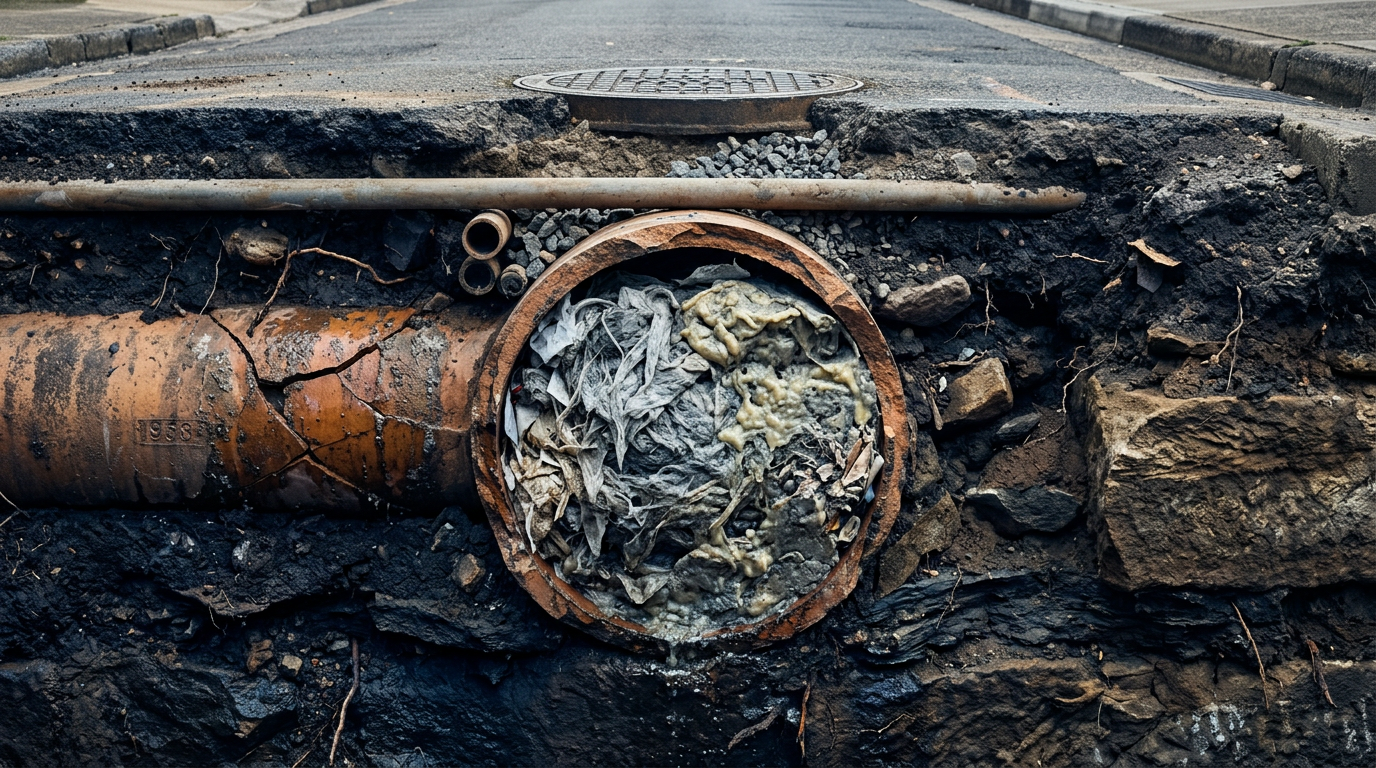
Ask any drainer working the inner west on a Monday morning what they pull out of Sydney sewers and you will get the same answer before you finish the question. Wipes. Grey, ropey, wound around a tree root like wool on a spindle, sitting in a 100mm earthenware line under a terrace in Newtown that was laid when horses still used the street. Behind the wipes there is usually fat, poured down a kitchen sink in Marrickville or Ashfield after a roast, cooled, hardened, and now acting like glue. Put the two together in a slow, flat, century-old pipe and you get a fatberg: a solid mass that no plunger and no supermarket drain powder will shift. Sydney Water spends millions every year cutting these out of the network, and since the October 2025 price determination took effect, that cost sits in the bill you pay each quarter. This guide covers what actually blocks Sydney pipes, why the label on the packet is not the whole story, the signs to watch for at home, and what a proper fix involves.
What a Fatberg Actually Is, and Why Sydney Grows So Many
A fatberg is not one thing. It is a composite. Fats, oils and grease go down warm, cool against the pipe wall, and set into a waxy coating. Anything fibrous that passes later gets caught in that coating instead of washing through.
Wipes are the perfect fibre for the job. They are made to hold together when wet, which is exactly what you want on a baby's skin and exactly what you do not want in a drain. Once a few snag on a joint or a root hair, they form a net, and the net catches everything behind it.
Sydney makes this worse in three ways. Much of the older inner and eastern suburb network is vitrified clay with mortar joints that have shifted over a hundred years. Falls are shallow on flat land like Alexandria and Botany, so flow is slow and solids settle. Tree roots from figs, liquidambars and camphor laurels give the wipes something to hang on, which is why tree roots in drains and wipe blockages usually turn up in the same camera run.
- Fats, oils and grease from cooking, which set hard as they cool
- Wipes, sanitary products, cotton buds and dental floss that do not break down
- Coffee grounds, rice and pasta that swell and settle in flat runs
- Root hairs at cracked joints that act as an anchor point for everything else
The Word Flushable Does Not Mean What You Think
A packet can be labelled flushable and still be the reason your sewer chokes. Flushable means the product clears the pan and the S bend. It says nothing about the twenty metres of pipe between your bathroom and the boundary, or the kilometres of Sydney Water main after that.
Toilet paper is engineered to fall apart in seconds of agitation. Most wipes are not. Consumer group CHOICE has tested this repeatedly, and their work on flushable wipes is worth five minutes of your time before the next supermarket shop.
The practical rule in a Sydney home is the three P rule. Pee, poo and paper. Everything else belongs in a bin, including the wipes marketed for bathroom use, the ones sold for cleaning, and the makeup removal pads that end up in the same place. Sydney Water's guidance on how to avoid wastewater overflows says the same thing in fewer words.
- Bin every wipe, including ones labelled flushable or biodegradable
- Bin sanitary items, nappies, cotton buds and dental floss
- Bin hair from the shower waste rather than pushing it through
- Keep a small lidded bin in the bathroom so the choice is easy to make

Your Kitchen Sink Is the Other Half of the Problem
Roast fat, bacon grease, olive oil and the film left on a baking tray all leave the kitchen as a warm liquid. Two metres of pipe later they are a solid. Hot water and detergent only move the problem further along the line, to a cooler section where it sets somewhere you cannot reach.
The result is a pipe that quietly narrows over years. A 100mm line with a 20mm grease lining behaves like a 60mm line, and it only takes one careless week for that to close completely. In terrace and townhouse rows the shared line means your neighbour's habits become your overflow.
Cafes and takeaway shops face a harder version of the same problem, which is why grease arrestor rules exist and why we cover them in the grease trap guide for NSW restaurants. Domestic kitchens have no arrestor at all, so the discipline has to happen at the bench.
- Pour cooled fat into a jar or the empty container it came in, then bin it
- Wipe greasy pans with paper towel before they reach the sink
- Use a sink strainer for scraps and empty it into the compost or bin
- Skip the caustic drain powders, which harden residue and attack old pipes
August Is When Sydney Notices, and Why That Timing Matters
Winter cooking is heavier. More roasts, more slow cooked meals, more fat down the sink than in January. Ground temperatures are also lower, so grease sets faster once it leaves the house.
Then spring rain arrives. Saturated ground pushes groundwater into cracked joints, flow rises, and a line that had been coping at fifty percent capacity suddenly cannot. That is the week the shower starts draining slowly and the overflow relief gully in the side yard starts doing its job.
The Bureau of Meteorology's seasonal outlooks give a fair warning of a wet run. If you have had a gurgle you have been ignoring since June, the fortnight before a wet spring is the cheapest time to deal with it.
There is a habit angle too. Households cook and clean differently through the cold months, and the extra fat, the extra paper towel and the extra hot washing all arrive in the same tired pipe. A line that was marginal in autumn is the one that fails in the first heavy week of September, usually on a weekend when nobody wants to be waiting on a plumber.
What This Is Doing to Your Sydney Water Bill
Clearing wipes and fat out of the network is not free. Crews, jetting trucks, pump station callouts and repairs all get funded through customer charges, and those charges are set by the regulator rather than chosen by the utility.
IPART's determination on Sydney Water prices from 1 October 2025 locked in a rising price path out to 2030, with wastewater service charges carrying much of the increase. You can see the current figures on Sydney Water's own prices page. The short version is that the bill you open in spring is bigger than the one you opened two years ago, and network maintenance is part of the reason.
There is a second bill risk that catches people out. A blockage that surcharges a line can force water past a failed joint, and a slow escape underground can run for a full billing cycle without a visible sign. Sydney Water's Hidden Leak Allowance can credit part of the water lost through a genuinely concealed leak, but only where a licensed plumber carried out the repair and you apply within the eligibility period with the invoice.
That allowance is the reason we tell every customer to keep two things after a job: the tax invoice and the CCTV footage. Without them the claim is difficult, and a single missed quarter of leaking water can cost more than the repair did. Our guide to hidden water leaks and bill shock walks through the application step by step.
- Compare your last four quarterly bills for a steady climb in usage
- Read the meter last thing at night and again before anyone showers
- Keep the plumber's tax invoice for the Hidden Leak Allowance claim
- Ask for the camera footage as a file, not just a verbal report
Warning Signs Before the Overflow
A sewer choke rarely arrives without notice. It sends signals for weeks, and most of them get explained away as a one off.
The clearest early sign is cross talk between fixtures. Flush the toilet and the shower waste gurgles. Empty the laundry tub and the toilet level rises or drops. That means air is being pushed through a partly blocked line rather than venting properly.
The next stage is smell. A sewer odour in a bathroom that comes and goes with the weather usually means a water seal is being pulled or pushed by pressure in the line, which we unpack in the guide to bathroom drain smells.
Keep a rough diary if you are not sure. Note the date each time a fixture gurgles or drains slowly, and note what the weather was doing. Two entries in a fortnight is a pattern rather than bad luck, and a camera run at that point costs a fraction of a bathroom clean up after a sewage overflow.
- Gurgling in one fixture when you use another
- A toilet that empties slowly then refills to an odd level
- Sewage smell in the yard near the overflow relief gully
- Water pooling around the gully grate after normal indoor use
- Two or more fixtures slowing down in the same week
How a Drainer Clears a Fatberg Properly
There is a difference between opening a hole and clearing a pipe. An electric eel punches through a wipe mass and restores flow for a fortnight. The fat lining stays on the wall, the wipe fibres re-catch, and you are back where you started before the next bill arrives.
High pressure water jetting cuts differently. A rotating nozzle scours the full circumference of the pipe, lifting the grease film and shredding the wipe mass so it flushes to the main. On old clay we drop the pressure and change the head, because the goal is a clean pipe rather than a fast one. The comparison between the two methods sits in our hydro jet versus electric eel breakdown.
Camera work is not optional afterwards. A CCTV drain inspection proves the line is clear, shows whether roots or a cracked joint caused the snag in the first place, and gives you footage for an insurer, a strata committee or a Hidden Leak Allowance claim. Where the camera finds a broken section, pipe relining seals it from the inside for roughly $450 per metre without digging up the courtyard.
Access matters more than most people expect. If your inspection opening has been paved over during a renovation, the drainer has to work through the boundary trap or lift a fixture, which adds time to every future job. Getting a riser fitted while the pipe is already open is a small cost that saves money on every visit after it.
- Locate and access the line through the inspection opening or boundary trap
- Jet the run at a pressure matched to the pipe material
- Camera the full length and record it
- Reline or repair any cracked joint that caused the catch point
- Set a maintenance interval if roots are present
Who Pays, and Where Your Responsibility Stops
In Greater Sydney the split is simple in principle. Everything from your fixtures to the boundary is yours. The main past that point belongs to Sydney Water, and if the choke is in their asset they clear it at no cost to you.
In practice the argument happens at the boundary trap, and a camera settles it in ten minutes. If the wipes are packed against a root mass three metres inside your fence, it is your repair. If they are sitting in the main, it is theirs. Our page on Sydney Water versus homeowner responsibility covers the edge cases including shared and easement lines.
Rentals and strata add a layer. Tenants are generally liable where misuse caused the blockage, which for wipes and fat is often provable on camera, while owners carry fair wear and tear and structural faults. NSW Fair Trading's guidance for plumbers and drainers is a useful reference when you need to check a licence before letting anyone near the line.
A Prevention Routine That Actually Holds
Prevention for drains is boring, which is why it works. Three habits and one scheduled job will keep most Sydney houses out of trouble.
The habits are a lidded bathroom bin, a fat jar on the kitchen bench and a sink strainer that gets emptied rather than rinsed. The scheduled job is a jetting and camera run at an interval matched to your property. A modern PVC line on a new build might go a decade. A clay line under a Federation home with a fig in the front yard wants attention every eighteen months to two years.
If you are buying, get it checked before you sign rather than after. The pre purchase drain check is the cheapest inspection in the whole conveyancing process and the only one that looks underground.
- Bin, not flush, every wipe and sanitary item
- Cool and jar cooking fat rather than pouring it away
- Strain the kitchen sink and clear the shower waste monthly
- Book a camera and jet run every 18 to 24 months on older clay lines
- Keep invoices and footage in one folder for insurance and bill claims
Book a Camera and Jet Run Before the Spring Rain Arrives
Express Drain Cleaning provides same-day drain clearing across Sydney, Newcastle and the Central Coast. Licensed, insured, upfront pricing.