
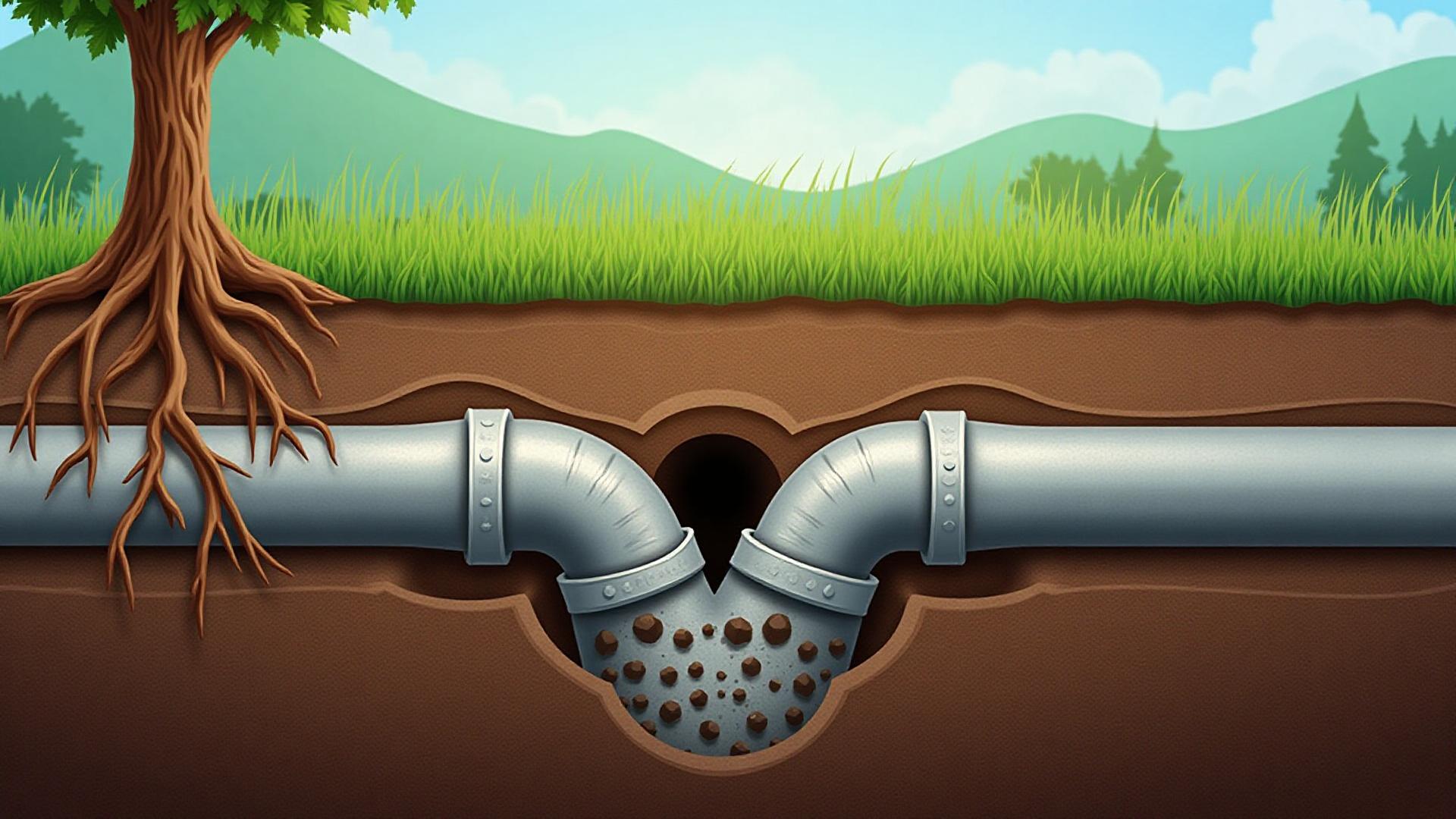
Tree Roots in Drains: Why Liquidambars and Jacarandas are a Plumber's Best Friend
Every spring across Sydney, Newcastle, and the Central Coast, the purple haze of Jacarandas and the lush greenery of Liquidambars transform our streets. While these trees are local icons, they are also a leading cause of blocked drains in New South Wales. For a plumber, these species are 'best friends' because they provide a never-ending stream of work, but for a homeowner, they can be a botanical nightmare. Understanding how these specific root systems interact with your underground clay or PVC pipes is the first step in avoiding an expensive emergency call-out.
The Usual Suspects: Why Liquidambars and Jacarandas Target Your Pipes
In established suburbs like Epping, Turramurra, or the older parts of Newcastle, the soil is often rich with heritage trees. The Liquidambar styraciflua (American Sweetgum) is notorious for its aggressive, wide-spreading root system that can lift concrete driveways and pierce old terracotta pipes. Similarly, the iconic Jacaranda mimosifolia, while beautiful, possesses a fibrous root mat that is incredibly efficient at finding moisture.
These trees don't 'attack' pipes out of malice; they follow moisture gradients. In the dry NSW summers, a tiny weep at a pipe joint—common in older earthenware pipes found in the inner-western Sydney suburbs—acts as a beacon. Once a microscopic root hair enters the pipe, it feasts on the nutrient-rich effluent, quickly swelling into a 'root ball' that can completely obstruct the flow of waste.
The Warning Signs of Tree Roots in Drains
Early detection is the difference between a simple maintenance clean and a $10,000 excavation. Many homeowners in the Hunter and Sydney regions ignore a gurgling drain, assuming it’s a one-off. However, because tree roots are living organisms, they don't just sit there; they grow thicker, eventually cracking the pipe wall or causing a total collapse.
If you live in a house built before the 1980s, you likely have clay pipes with rubber or mortar joints. These are far more susceptible than modern PVC. If you notice any of the following, tree roots have likely already breached your line:
- Gurgling sounds from your toilets or kitchen sinks when the washing machine drains.
- Sewage smells emanating from backyard gully traps or overflow relief gullies (ORG).
- Slow-draining fixtures throughout the house, rather than just one isolated sink.
- Patches of unusually lush, green grass in your lawn, even during a Central Coast dry spell.
- Visible 'sinkholes' or soft spots in the soil above where your sewer line runs.
The Cost of Remediation in NSW: Jetting vs. Relining
When we arrive at a property in Lake Macquarie or the Northern Beaches, our first step is a CCTV drain camera inspection. This allows us to see exactly where the roots have entered. A standard CCTV inspection usually costs between $200 and $450.
If the roots are manageable, we use high-pressure water jetting. Unlike the old-fashioned 'electric eel' which often just pokes a hole through the roots, a hydro-jetter scours the pipe walls clean. A professional jetting service typically ranges from $350 to $900 depending on the complexity and time required.
For pipes that have been structurally compromised by a massive Liquidambar root, 'trenchless pipe relining' is the gold standard. Instead of digging up your landscaped garden or driveway, we insert a resin-filled liner that creates a 'pipe within a pipe'. In Sydney and Newcastle, relining costs generally sit between $400 and $900 per linear metre. While expensive upfront, it is often cheaper than excavating through sandstone or expensive tiling.
Council Rules and Utility Responsibility
A common point of confusion for homeowners in the Sydney Water or Hunter Water catchments is who pays for the fix. As a general rule, the homeowner is responsible for all sanitary drainage within their property, right up to the point of connection with the main sewer. This is known as the 'Point of Connection'.
If a council-owned Jacaranda on your nature strip sends roots into your private pipes, you are still generally responsible for the repair within your boundary. Most NSW councils (like Central Coast Council or City of Sydney) will not pay for private plumbing repairs caused by their trees. However, if the root blockage is occurring in the 'junction' where your pipe meets the main street sewer, Sydney Water or Hunter Water may be responsible for the clearance. We always recommend getting a CCTV footage report to prove the location of the blockage before contacting the water authority.
Preventing Future Root Intrusion
If you are planning your garden in a new development in areas like Box Hill or Wyong, be strategic. Avoid planting large, thirsty trees directly over the 'sewer peg'—the point where your house connects to the main line. If you already have a mature Liquidambar or Jacaranda, you don't necessarily need to cut it down. Annual maintenance is key.
Scheduling a preventative jet-clean every 12 to 18 months can keep root growth at bay before it becomes a structural problem. Furthermore, if you are replacing old clay pipes, ensure your plumber uses modern PVC with solvent-welded joints, which are significantly harder for roots to penetrate than the old push-fit or mortar joints.
Stop Invasive Roots Before They Destroy Your Pipes. Call Our Specialist Drain Team Today.
Express Drain Cleaning provides same-day drain clearing across Sydney, Newcastle and the Central Coast. Licensed, insured, upfront pricing.