

Hidden Water Leaks in Sydney: How to Beat the 2026 Bill Shock Before Winter
Walk down any street in Marrickville, Hornsby or Mosman this week and listen carefully near the front kerb. The faint hiss you can sometimes hear, even when no taps are running inside the house, is usually water escaping from a hidden leak somewhere between the meter and the kitchen sink. With Sydney Water's IPART-approved price increase rolling out from 1 July 2026, that hiss is about to get a lot more expensive. The average Sydney household water bill is climbing roughly 18 percent across the four-year pricing period, which means a small leak you ignored last winter could quietly add hundreds of dollars to next quarter's bill. The good news is that most hidden leaks in Sydney homes are detectable in under five minutes using a tool you already own: your water meter. And if a leak does slip through, the Sydney Water Hidden Leak Allowance can refund a meaningful chunk of the bill, but only if you act fast and meet a list of conditions most homeowners have never read.
Why winter is when Sydney's hidden leaks finally show up
Sydney's plumbing has a seasonal rhythm. In summer, evaporation and garden watering mask small leaks because the numbers on the bill look normal. By late autumn, when the sprinklers are off and the pool top-ups stop, every extra litre on the meter has nowhere to hide. That is why our phones in Cremorne, Ryde and Gosford ring hardest in June and July.
Cold mornings also matter. When overnight temperatures drop below about 8 degrees in the upper North Shore and Blue Mountains foothills, copper pipes contract slightly. A pinhole that was weeping a teaspoon an hour in March can open into a steady drip by mid-June. Combine that with the new pricing period that starts 1 July and you have the perfect storm for an unexpected $400 quarterly bill.
Most of the leaks we find at this time of year are not dramatic. They are the boring ones: a slowly failing flexi hose under a vanity in Lindfield, a corroded joint behind a Hamilton laundry, a hairline crack in a slab-laid pipe in a 1990s Kellyville home. None of these will flood your kitchen. All of them will quietly drain your wallet for months if nobody runs the two-minute meter test described below.
There is also a less obvious winter trigger: heavier rainfall in May and June raises the water table across parts of the Northern Beaches, the Central Coast and the lower Hunter. A pipe joint that was sitting in dry soil all summer is suddenly saturated, which both accelerates corrosion and makes the leak harder to hear with the naked ear. By the time the bill confirms the problem, the leak has often been running for two full months. Catching it before the July meter read is the difference between a $120 repair and a $900 surprise.
What the Sydney Water Hidden Leak Allowance actually covers
The Hidden Leak Allowance is Sydney Water's official rebate program for concealed leaks on the private side of the meter. It exists because the law is otherwise brutal: every drop that passes through your meter is your responsibility, even if it is leaking from a pipe buried under your slab. The allowance softens that, but it is narrow and time-limited.
To qualify, the leak must be genuinely hidden, which means underground, inside a wall cavity, under a concrete slab, or otherwise impossible to spot during a normal inspection. A dripping tap, a running toilet cistern or a visibly damaged garden tap do not qualify, no matter how much water they wasted. You also need a licensed plumber's written report confirming the location and date of repair, plus the repair invoice. Sydney Water then credits the usage charges above your normal consumption for the affected billing period, up to set limits.
Three details catch most homeowners out. First, you must apply within 12 months of the repair. Second, the allowance only covers the water usage charges, not the fixed service charges or sewerage usage. Third, Sydney Water will compare the leaking quarter against your historical average, so if you have only lived in the property for one quarter they may use neighbourhood averages instead. For a deeper look at who owns which pipe at the boundary, see our guide on where Sydney Water's responsibility ends and yours begins.
- Eligible: slab leaks, underground service line leaks, concealed wall-cavity leaks.
- Not eligible: dripping taps, running toilets, visible garden tap leaks, pool top-ups.
- Required: licensed plumber's report, repair invoice, application within 12 months.
- Covers: water usage charges above your historical average for the affected quarters.
- Does not cover: fixed service charges, sewerage usage charges, or stormwater charges.
How much the July 2026 Sydney Water price rise will add to your bill
IPART's final determination for Sydney Water's 2025 to 2030 pricing period locked in real-terms increases to both the fixed service charge and the per-kilolitre usage rate. For a typical Sydney household using around 200 kilolitres a year, the all-in annual bill is expected to climb by roughly $230 to $280 across the period, with the first step landing on 1 July 2026.
That sounds modest until you stack a hidden leak on top. A continuous leak of just 1 litre per minute, which is about the flow of a slow-running cistern, adds 525 kilolitres per year. At the new usage rate plus the higher wastewater usage component, that single leak alone can push a quarterly bill past $900 above normal. Run the maths the other way: finding and fixing that leak in June pays for the plumber roughly six times over by the following autumn.
Renters are not off the hook either. Under most NSW tenancy agreements, water usage charges are passed through to the tenant if the property is separately metered and meets minimum water efficiency standards. If you are renting and the bill jumps, the question of who pays for the leak repair and the wasted usage is governed by the rules in our tenant or landlord guide.
Seven signs you already have a hidden water leak
Sydney homes drop plenty of clues before the bill arrives. The trick is knowing which ones to take seriously and which are just normal building behaviour. Walk through the house this weekend and look for any of the following.
- A quarterly water bill more than 20 percent higher than the same quarter last year, with no change in household size or habits.
- Damp, musty or earthy smells in a single room, especially a wall that backs onto a bathroom, laundry or kitchen.
- Hot spots on a ground-floor concrete slab in winter (a slab leak on a hot water line warms the floor noticeably).
- Unexplained green patches in an otherwise tired lawn during the cooler months when nobody is watering.
- A faint hissing or trickling sound when every tap, toilet and appliance is switched off.
- Cracked, lifting or stained skirting boards in older Eastern Suburbs and Inner West homes built before 1980.
- Water pressure that has slowly dropped at one tap, suggesting flow is being lost somewhere upstream.
The two-minute water meter test every Sydney homeowner should run
Every Sydney property has a water meter, usually in a black or green box near the front boundary. Inside is a dial with a small red or black triangle, star or wheel called the leak indicator. If any water at all is moving through the meter, that indicator spins. This is the single most reliable home leak test you can do.
Pick a 10 minute window when nobody is using water. Turn off every tap, the dishwasher, the washing machine and the icemaker. Pause the irrigation controller. Note the exact reading on the meter, including the last red digits. Walk away for two minutes, come back, and read it again. If the numbers have moved, or the small leak indicator has rotated, water is escaping somewhere on your property.
- Step 1: Locate the water meter at the front boundary.
- Step 2: Close every tap and pause every water-using appliance inside and outside the house.
- Step 3: Photograph the meter face, including the leak indicator position.
- Step 4: Wait two minutes without touching any tap or fitting.
- Step 5: Photograph the meter again and compare the leak indicator and digits.
- Step 6: If anything has moved, isolate the house at the internal stop tap and repeat. If movement stops, the leak is inside; if it continues, the leak is between the meter and the house.
Where hidden leaks hide in older Sydney homes
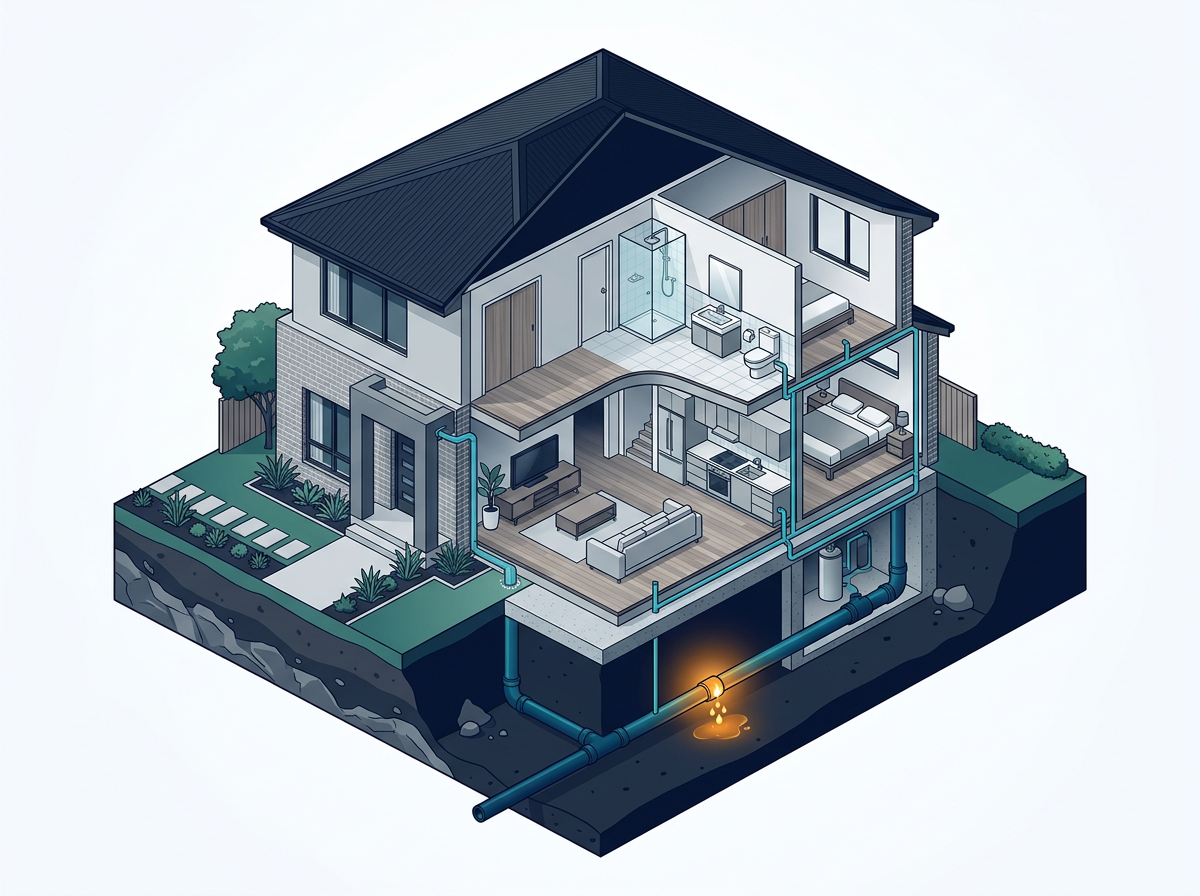
Sydney's housing stock is a patchwork of eras, and each era has its own weak spot. Knowing the building's age narrows the search dramatically. Pre-war homes in Glebe, Newtown and Annandale almost always have galvanised steel service lines that corrode from the inside. By the time the leak appears on the meter, the pipe wall is usually paper-thin along its entire length, which is why a single repair rarely solves the problem.
Post-war fibreboard and brick veneer homes across Ryde, Eastwood and Carlingford typically have copper pipework that lasts well, but the flexible braided hoses under sinks have a published lifespan of only about ten years. Sydney Water has flagged failed flexi hoses as one of the largest single causes of insurance water damage claims in NSW. Check the date stamp on yours.
Slab-on-ground homes from the 1980s onward in places like Castle Hill, Baulkham Hills and Bella Vista hide their pipes inside the concrete. Slab leaks here are notoriously hard to find without acoustic equipment or thermal imaging, which is one reason a CCTV inspection is often the cheapest next step before any digging or jackhammering is done. If you are weighing repair against full replacement of an old service line, the trade-offs are covered in our pipe relining versus replacement guide.
Apartments and townhouses on the Lower North Shore and around Parramatta have their own quirk. The Sydney Water meter is usually for the whole strata complex, so a hidden leak inside one unit shows up first as a building-wide bill increase that the strata manager passes back through levies. If your levies jumped this quarter and the building is more than 20 years old, push for a leak detection inspection of the common pressure lines before assuming the increase is just inflation. Acting early protects the body corporate's chance of claiming the Hidden Leak Allowance on the strata account.
How professional leak detection works (and why DIY usually stops here)
Once the meter test confirms a leak, the goal shifts from detection to location. Guessing wrong here is expensive: cutting open the wrong wall or slab section can cost more than the leak itself. A licensed leak detection plumber uses three tools in combination to pinpoint the source without unnecessary destruction.
Acoustic listening devices amplify the sound of escaping water through a sensitive ground microphone. On a quiet Sydney street, a trained ear can locate a slab leak to within 20 centimetres. Thermal imaging cameras pick up the temperature difference between a hot water leak and the surrounding slab or wall. Tracer gas, usually a safe hydrogen and nitrogen mix, is injected into the isolated pipe and detected at the surface where it escapes. Together, these methods locate around 95 percent of hidden leaks without any exploratory damage.
The cost of a professional leak detection visit in Sydney typically sits between $350 and $650 depending on access and complexity. Compared to the open-ended cost of an undetected slab leak running for another quarter, plus the lost Hidden Leak Allowance window, it is rarely the wrong call. Our emergency drain and leak team covers Sydney, Newcastle and the Central Coast on the same day, and we provide the written report Sydney Water requires for the allowance application.
What to do this week before your next bill lands
Sydney Water reads most residential meters quarterly, which means the meter that ticks over today shapes the bill that arrives in roughly three months. If you act in the next seven days, you can still influence the July to September quarter, which is the first full billing period under the new prices.
Start with the two-minute meter test above. If it comes back clean, check every flexi hose under every sink and behind every washing machine for rust, bulging or a date stamp older than 2016, and replace any that fail. If the test shows movement, photograph the meter, isolate the house at the internal stop tap, and call a licensed plumber the same day. Save every photo and every invoice in one folder, because that folder is what unlocks the Hidden Leak Allowance later.
- This week: run the two-minute meter test and photograph the result.
- This week: replace any flexi hose older than 10 years (about $25 per hose).
- This week: check that your stop tap turns freely so you can isolate the house in an emergency.
- This month: review last winter's water bill and compare consumption to this year's.
- Within 12 months of any repair: lodge the Hidden Leak Allowance application with the plumber's report and invoice.
Suspect a hidden leak? Get a licensed Sydney leak detection visit this week.
Express Drain Cleaning provides same-day drain clearing across Sydney, Newcastle and the Central Coast. Licensed, insured, upfront pricing.