
Sydney's Old Clay Drains: Why Earthenware Pipes Fail
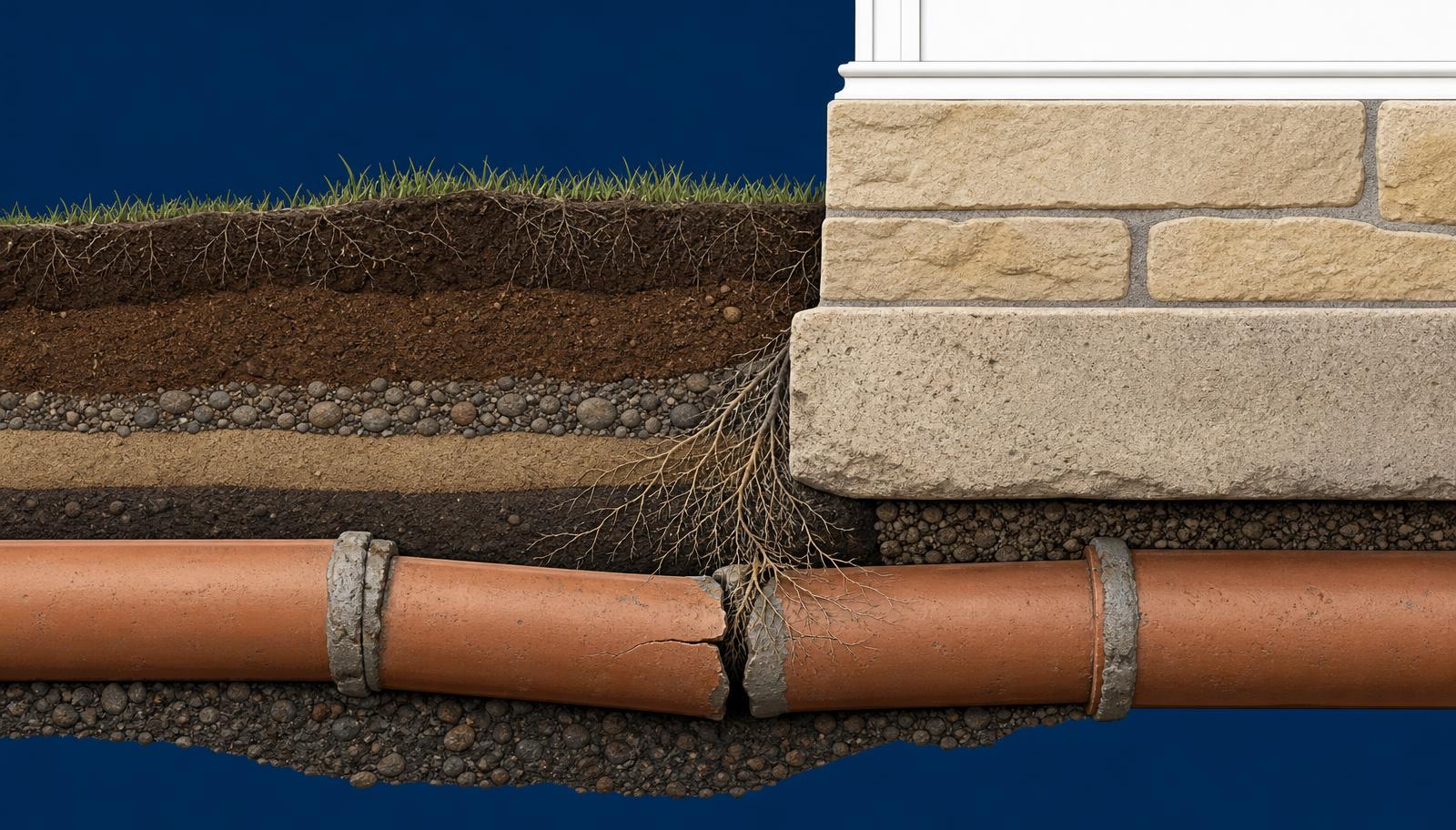
Walk any street in Haberfield, Lane Cove or Hamilton and you are walking above a drainage system laid when the milk still came by cart. Under those front lawns sit short lengths of orange earthenware pipe, joined with mortar or a rubber ring, buried a metre down in clay and sandstone that has moved every wet and dry season since. The pipe itself has barely aged. The joints have not been so lucky. Spring is when this shows up, because the ground swells after a wet Sydney winter, jacaranda and liquidambar roots wake up hunting moisture, and the first heavy September downpour pushes a load through pipework that has been quietly cracked for years. The result lands as a slow shower, a gurgling gully, a soggy patch beside the path, or a water bill that climbed for no reason anyone in the house can explain. This guide covers what earthenware pipe is, why it fails in Sydney specifically, what fixing it costs in 2026, and how the price of leaving it alone has changed since Sydney Water reset its charges.
What Earthenware Pipe Actually Is, and Why Sydney Is Full of It
Earthenware, also sold as vitrified clay, is fired clay pipe made in short lengths, usually 600 millimetres to a metre, with a socket at one end. It was the standard house drain material across Sydney, Newcastle and the Central Coast from the late 1800s until PVC took over through the 1970s and early 1980s. If your home was built before roughly 1975 and the drainage has never been dug up, you almost certainly still have it.
The material has one real strength. Fired clay does not corrode, does not soften, and shrugs off the acids that eat cast iron and concrete, which is why hundred year old sections still run clean when they are left undisturbed. The weakness is everything around it.
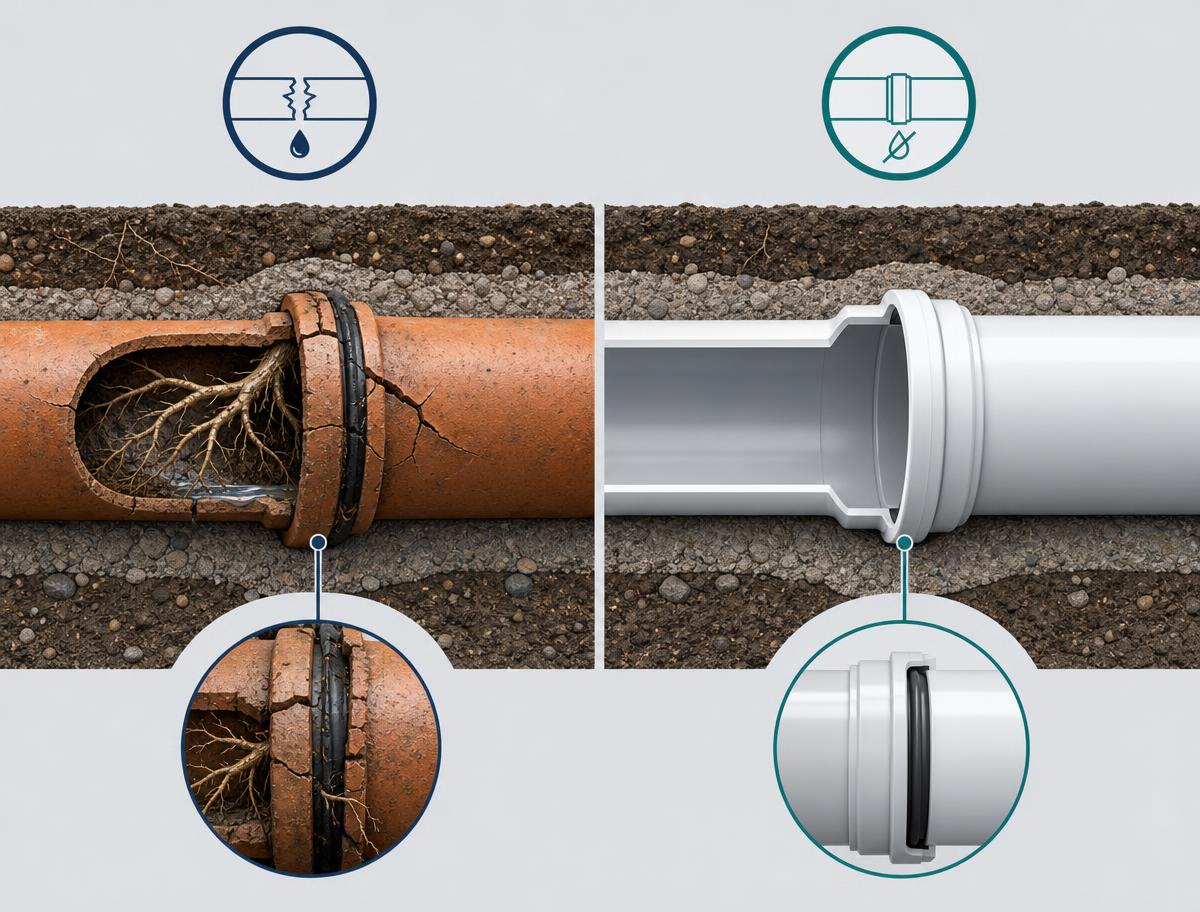
Every metre of earthenware drain has at least one joint, and older joints were sealed with cement mortar mixed on site. Mortar is rigid, porous and thin at the crown of the socket. Once ground movement flexes the line, the mortar cracks before the pipe does, and the crack becomes a doorway for roots, soil and water.
- Pipe length: short sections, so a 20 metre house drain can hold 25 or more joints
- Joint types: cement mortar on pre 1960s work, rubber ring on later runs
- Typical depth: 600 millimetres to 1.5 metres in most Sydney backyards
- Common sizes: 100 millimetre house drains, 150 millimetre for larger or shared lines
- Life expectancy: the pipe outlasts the joints by decades
The Sydney Ground Conditions That Break the Joints
Soil is the difference between a clay drain that runs for a century and one that fails in forty years. Sydney sits on a patchwork of reactive shale clay, sand and sandstone shelf, and each behaves differently under the same rainfall.
Reactive clay swells when it takes on water and shrinks back when it dries. Through the inner west, the upper North Shore and the Hunter, that seasonal movement lifts and drops a buried drain by a few millimetres each cycle. A rigid mortar joint has no give in it, so the movement is absorbed by cracking.
Sandstone country behaves the opposite way. Around Mosman, Seaforth and Woolwich, pipes were often bedded straight onto rock or into a chiselled trench with poor backfill. The pipe cannot move at all, so any shift in the house above concentrates load on one point of the line.
Add the third factor, which is what the pipe was carrying, and the pattern becomes predictable. Sections downstream of a kitchen fill with cooled fat, sections under a driveway carry traffic load that was never designed for, and sections beside a large street tree face a root system doing the same work every spring.
- Reactive shale clay: seasonal swell and shrink cracks mortar joints
- Sandstone shelf: rigid bedding concentrates load and snaps pipe barrels
- Filled or reclaimed ground near the harbour and lakes: long term settlement pulls joints apart
- Driveways and carports built over an old line: point loading with no protection slab
- Street tree verges: constant moisture hunting at every joint
How Tree Roots Find a Joint That Has Barely Moved
Roots do not smash into a sound pipe. They follow moisture vapour escaping from a hairline gap, then thicken inside the pipe where conditions are ideal. A root the width of a hair in March can be the width of your thumb by the following spring.
Once inside, the root behaves like a net. Paper, wipes, grease and grit catch on it, the flow slows, and the blockage builds behind a point you cannot see from any fixture in the house. That is why the first symptom is usually the fixture furthest from the street, most often a shower or a laundry tub.
Liquidambars, jacarandas, camphor laurels and figs cause most of the damage we cut out across the North Shore and Newcastle. If you want the full species by species picture, our guide to tree roots in drains covers which trees to worry about and what council will and will not let you remove.
Cutting roots out restores flow for a season or two. It does not close the crack that let them in, which is the part most quotes quietly skip over.
The Warning Signs Worth Acting On This Spring
Earthenware failure is slow, and that works against homeowners. The signs arrive one at a time over a couple of years, each small enough to ignore, until a Saturday night when the toilet will not clear.
Take any two of the following together as a reason to look inside the pipe rather than wait.
- A shower or laundry tub that drains slower each month while other fixtures are fine
- Gurgling from a floor waste or gully when the washing machine empties
- A patch of lawn that stays green and soft through a dry fortnight
- Sewage smell in the yard after rain, strongest near the boundary or the gully grate
- Recurring blockages in the same spot, clearing easily then returning within months
- Paving, path or driveway slabs that have dropped or cracked in a line
- A water bill that lifted with no change in how the house is used
Why a Cracked Clay Drain Costs More in 2026 Than It Did in 2024
The repair price has moved a little. The cost of doing nothing has moved a lot, and that is the part most owners have not priced in.
Sydney Water reset its charges from 1 October 2025 following the regulator's determination, lifting the fixed service charges and the per kilolitre usage rate together. Wastewater and stormwater lines moved with them. A household that changed nothing at all is now paying more per litre than it was two winters ago, and you can see the current structure on the Sydney Water accounts and billing pages.
That reset matters to drainage because a failed clay joint rarely stays a drainage problem. Where a broken sewer line sits alongside a water service in the same trench, ground washout and constant saturation put pressure on the water line too, and a pinhole leak on a pressurised pipe runs 24 hours a day at the new rate. Water leaving your system that way is billed to you until it is found.
The other half of the arithmetic is damage. Saturated soil beside a footing softens the bearing ground, which is how a drainage fault turns into a structural repair over a couple of seasons. Fixing 4 metres of pipe is cheap next to underpinning a wall.
The Hidden Leak Allowance, and How Clay Drains Fit Into It
Sydney Water runs a Hidden Leak Allowance for customers hit with a high bill caused by a leak that could not reasonably have been seen. It is a partial credit against the excess water, not a repair fund, and the rules are set out on the Sydney Water Hidden Leak Allowance page.
The critical distinction is where the leak sat. A leak underground, under a slab or inside a wall cavity generally qualifies. A dripping tap, a running toilet cistern or a visible burst you walked past for a month does not, because it was there to be seen.
Claims succeed on paperwork, so the order of work matters. Get the fault found and documented, get it repaired by a licensed plumber, keep the invoice with the date and the location of the fault written on it, then lodge the claim with your meter readings before and after. Camera footage of the failed section is the strongest single piece of evidence you can attach.
A cracked earthenware sewer on its own does not usually create a billable water loss, because nothing pressurised is escaping. Where it counts is the diagnosis. The same inspection that finds the broken drain very often finds the saturated ground and the water service failure sitting next to it, and that is the leak the allowance is written for. Our walkthrough of what every charge on your bill means shows exactly which line the loss appears on.
- Document the fault before the repair, not after
- Keep the licensed plumber's invoice with the fault location written on it
- Record meter readings on the day of repair and a week later
- Lodge within the timeframe Sydney Water sets for the billing period
- Attach CCTV stills or footage where the fault was underground
Finding the Fault Without Digging the Yard Up
Guesswork is expensive with clay. The line runs where the plumber of 1928 decided it should run, not where the paperwork says, and the first crack is rarely at the point where the water surfaces.
The starting point is a CCTV drain inspection. A camera on a flexible rod runs the full line from the gully or an inspection opening, and a sonde on the head lets us mark the depth and position of the fault on the surface with paint. You see the footage, so the quote stops being a story and becomes a picture of your pipe.
Where the line is blocked before the camera can pass, we clear it first with high pressure drain jetting, which cuts roots and scours the wall back to bare clay so the camera reads the joint honestly rather than through a film of grease.
If the property has an old boundary trap, the survey should include it. Those brick or clay chambers at the front of older Sydney blocks are a common failure point in their own right, and our boundary trap guide explains how to identify one and who is responsible for it.
Repair Options and What They Cost in 2026
Once the fault is on film, there are three honest paths, and the right one depends on how much of the line is failing rather than on what anyone would prefer to sell.
Maintenance clearing suits a line with sound joints and a single root entry. Jetting on a two or three year cycle keeps it running, and for a rental or a house being sold soon it is a reasonable call.
Pipe relining suits most failed earthenware. A resin saturated liner is pulled through the existing pipe and cured in place, forming a jointless pipe inside the old one. The joints that were the weak point simply stop existing, and nothing above ground gets dug up. Expect a range of roughly 550 to 950 dollars per metre depending on diameter, access and how many junctions need reinstating.
Excavation and replacement still wins in two cases. Where the pipe has collapsed and lost its shape, or where the line has dropped and holds water, a liner will only reproduce the fault in resin. A short dig of 2 to 4 metres in accessible ground typically runs 3,500 to 7,000 dollars, and rises quickly under a driveway or a paved courtyard.
- Jetting and root cutting: several hundred dollars, buys two to three seasons
- Patch lining of a single joint: usually 1,200 to 2,500 dollars
- Full relining of a house drain: roughly 550 to 950 dollars per metre
- Open cut replacement: 3,500 to 7,000 dollars for a short accessible section
- Reinstating paving, concrete or landscaping after a dig: charged separately
Who Pays, and Where the Responsibility Line Sits
In Sydney the property owner is responsible for the drainage on the property, from the fixtures out to the connection point at the boundary. Sydney Water owns the main and the connection beyond it. If the blockage or break is on your side of that line, the repair is yours, and the same principle applies with Hunter Water and Central Coast Council in the northern service areas.
For rentals in NSW, the owner is responsible for the pipework itself. Tenants are on the hook only where the blockage came from misuse, such as wipes or fat down a sink. Fair Trading sets out the licensing and repair framework on its plumbing and drainage pages.
Strata is different again. Common property drainage below a unit floor is generally the owners corporation's cost, and only the branch inside the lot is the owner's. The strata repairs and maintenance guidance is the reference to hand your committee when the argument starts.
Before any building work goes over the top of a drain, check the asset requirements first. Sydney Water publishes what is allowed near its assets in the plumbing, building and developing section, and getting this wrong is how a new deck ends up sitting over a pipe nobody can reach.
A Practical Spring Plan for an Older Sydney Home
September and October are the sensible months for this work in NSW. The ground has drained enough to dig or line cleanly, root growth is at its most aggressive so a camera shows the real story, and the storm season is close enough that any stormwater fault you find is worth fixing now rather than in February. The Bureau of Meteorology's seasonal climate summaries for NSW are a useful check on how wet the ground has been where you live.
Work through it in this order and you will spend the least money for the most certainty.
If the house is being sold or bought this spring, do the camera survey before contracts rather than after. A documented drain either supports your price or gives the buyer's side something to negotiate with, and it is the cheapest condition report on any older property. Soil condition matters here too, and the CSIRO's soil research explains why reactive ground behaves the way it does under a slab.
- Read your meter with every tap off, then read it again an hour later
- Compare the last two bills for a usage jump that nobody in the house can explain
- Clear gutters, downpipes and the gully grate before the first heavy storm
- Book a CCTV survey of the full house drain if the property predates 1975
- Fix the failed joints before summer rather than clearing the same blockage twice
- Keep the footage and the invoice on file for insurance and for any allowance claim
Book a camera survey of your old clay drain before storm season
Express Drain Cleaning provides same-day drain clearing across Sydney, Newcastle and the Central Coast. Licensed, insured, upfront pricing.