
Sydney Water Bill Explained: What Every Charge Means
There is a particular quiet that falls over a kitchen in Chatswood or Merewether when the quarterly water bill is opened at the bench. Nobody in the house has watered a lawn, filled a pool or run the washing machine any harder than last year, yet the total has moved again. Then the page turns and the confusion starts properly, because the bill is not one number. It is a stack of service charges, a usage charge, a wastewater line and sometimes a stormwater drainage line, all landing at once under prices IPART approved from 1 October 2025 that are now flowing through a full year of accounts. Most people pay it and move on. That is the expensive habit. Buried in those lines is the clearest early warning you will ever get that a pipe under your house or yard has failed, and the same lines decide whether Sydney Water hands part of the money back to you. This guide walks the bill from top to bottom in plain language, and shows where a drainage fault hides inside it.
Why This Bill Looks Different to the One You Filed Last Year
Sydney Water prices reset on 1 October 2025 under a determination from the Independent Pricing and Regulatory Tribunal. That reset lifted the fixed charges and the per kilolitre usage rate at the same time, which is why a household that changed nothing still sees a higher total. The winter and early spring accounts landing now are the first ones many owners can compare against the same season a year earlier at like for like rates.
The change matters more than the percentage suggests, because it changes the cost of a fault. A slow leak that quietly wasted 40 kilolitres a quarter used to be an irritation. At current rates it is a serious bill, and it repeats every quarter until somebody finds it. Older suburbs feel it first. Clay sewer lines through Willoughby, cast iron and copper through Hamilton, and pressure mains cut into sandstone across the North Shore all fail slowly rather than dramatically.
There is a second reason the bill reads oddly this year. Sydney Water has been steadily moving customers onto more frequent meter reads, so an estimated read followed by an actual read can produce one flat quarter and one alarming one. Before you assume a leak, check whether the bill says estimated or actual. You can confirm the current rates on the Sydney Water prices page and read the reasoning behind the increase in the IPART determination for Sydney Water.
The Four Charges That Make Up Almost Every Sydney Bill
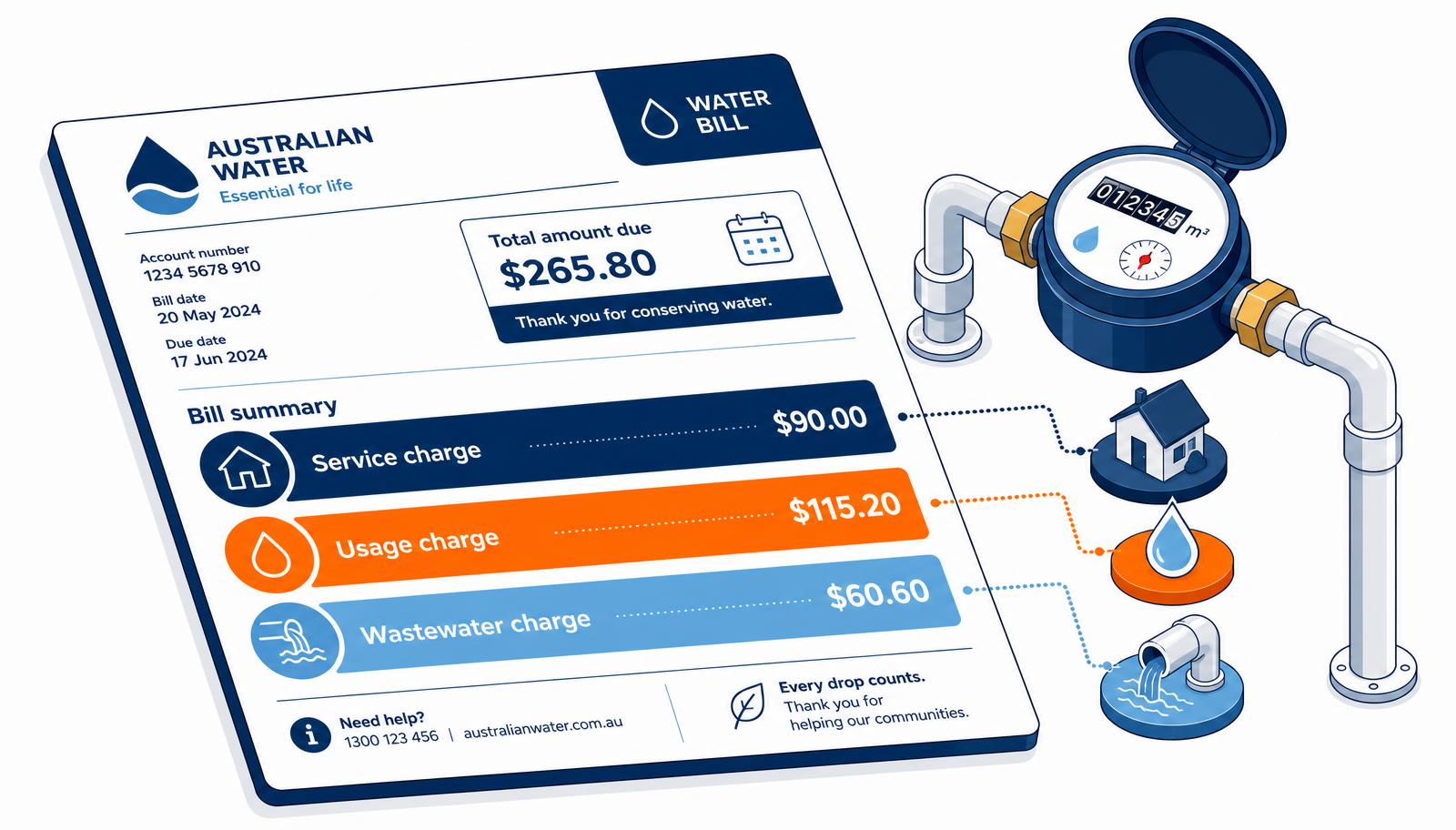
Strip away the branding and the payment options and a residential account comes down to four things. Two of them arrive whether you use water or not. Two of them move with what happens inside your property. Knowing which is which tells you instantly whether you have a pricing problem or a plumbing problem.
Only the usage lines respond to a leak. If the fixed charges rose and usage stayed flat, your pipes are fine and the price rise explains the account. If usage jumped while the household stayed the same size, something is running that you cannot see. Sydney Water sets out the same structure in its own guide to reading your bill.
- Water service charge: a fixed quarterly amount for being connected to the drinking water network, based on meter size rather than use.
- Water usage charge: every kilolitre that passes the meter, billed at a set rate per 1,000 litres.
- Wastewater service charge: a fixed amount for the sewer connection, usually the single largest line on a house account.
- Wastewater usage charge: applies to most business accounts and to some residential properties, calculated as a discharge factor applied to your water use.
- Stormwater drainage charge: added where the property sits inside a Sydney Water stormwater drainage area, common across parts of the inner north and lower North Shore.
The Line Where a Blocked or Broken Drain Shows Up
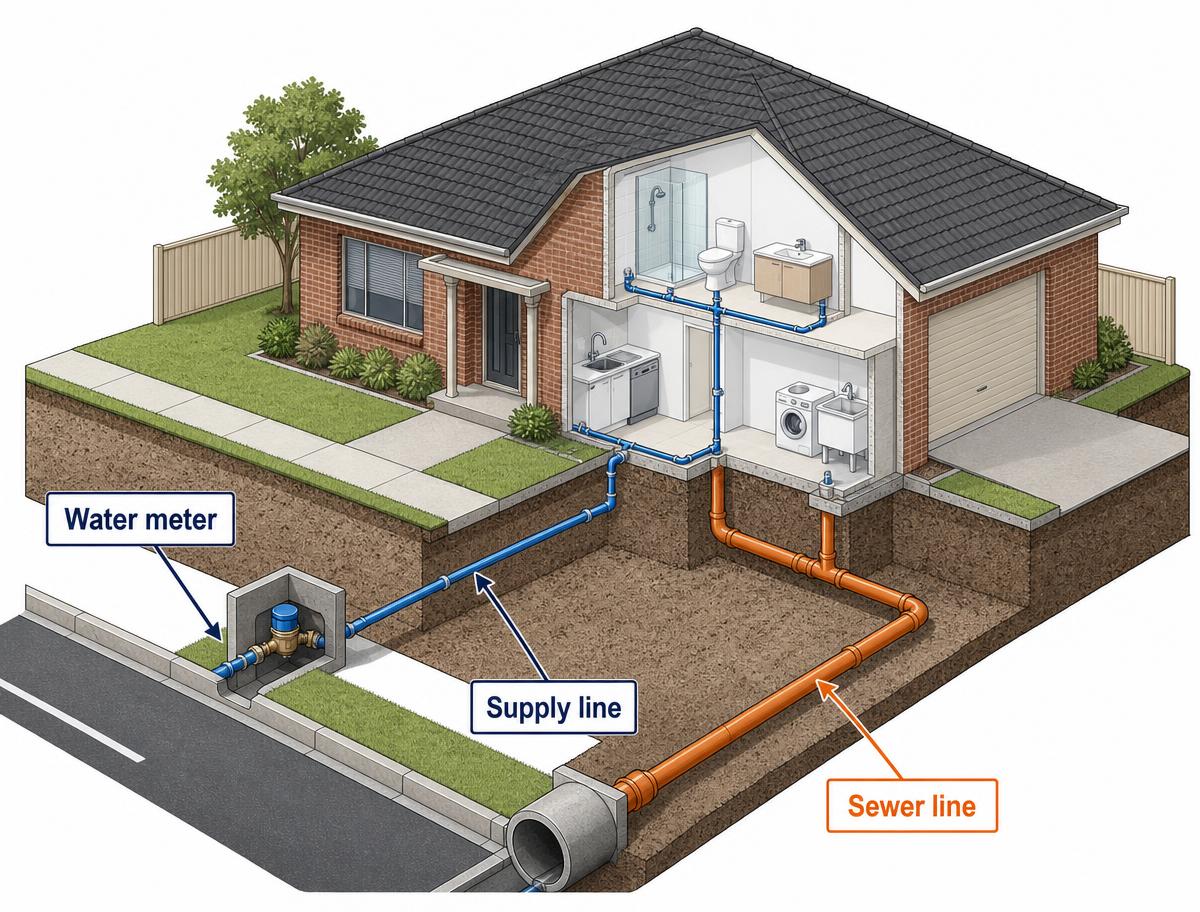
Owners assume drainage faults are invisible on a bill because sewage leaving the house is not metered directly. That is only half right. For most homes the wastewater usage charge is worked out by taking metered water in and applying a discharge factor, so anything that inflates water use also inflates the wastewater side. One leak can push two lines at once.
Worse, some faults pull water in the other direction. A cracked sewer line under a Newcastle backyard lets groundwater and stormwater into the pipe during heavy rain. That does not show as usage, but it does show as repeated surcharges at the overflow gully, sewage smell after storms and eventually a bill for emergency clearing rather than a maintenance job. The pipe is telling you long before the flood does.
A third pattern is the one we see most in strata and dual occupancy properties. A shared meter serves several dwellings, one toilet cistern runs continuously, and the cost is spread across owners who each think their own use is normal. Nobody investigates because no single bill looks catastrophic. A CCTV drain inspection camera and a meter isolation test settle it in under an hour. Shared lines in commercial and strata buildings are the worst offenders.
How to Tell a Price Rise From a Leak in Ten Minutes
You do not need a plumber to do the first check. You need the bill, a torch and the discipline to leave the taps alone for a couple of hours. The point is to separate two questions that homeowners usually collapse into one: did the rate change, and did the volume change.
Work through it in order. If the overnight test moves at all, stop guessing and get the property checked. Water moving through a closed house is never harmless.
- Find the kilolitres used on this bill and on the same quarter last year. Compare volume, not dollars.
- Check whether either read is marked estimated. An estimate followed by a catch up read explains many one off spikes.
- Turn off every tap and appliance, then read the meter and write the number down.
- Read it again after two hours with nothing in use. Any movement means water is leaving the system somewhere.
- Lift the overflow relief gully in the yard and look for standing water or debris, which points to a drainage fault rather than a supply one.
- Check the toilet by putting a few drops of food colouring in the cistern and waiting twenty minutes without flushing.
The Hidden Leak Allowance and What It Really Covers
Sydney Water runs a Hidden Leak Allowance for customers who have been billed for water lost through a leak they could not reasonably have seen. It is the single most useful thing on a high bill, and the least understood. It is not a refund of the whole account and it is not automatic. You apply, and the decision turns on whether the leak was concealed and whether you fixed it promptly.
Concealed means underground, under a slab, inside a wall or otherwise out of sight. A dripping garden tap, a running toilet you could hear, or an irrigation line lying on the surface will not qualify. The allowance usually covers a share of the excess water and, where applicable, the excess wastewater usage attached to it, and it is generally available once in a set period, so spending it on a leak you already knew about is a poor trade.
Timing is where most claims fall over. You need a plumber's invoice showing the leak was located and repaired, and you need it within the window. Get the repair documented properly at the time, not reconstructed later from memory. The current criteria sit on the Sydney Water hidden leak allowance page.
Renting, Landlords and Who Pays for What in NSW
Water charges on a rented property in NSW follow rules that surprise both sides. A landlord can only pass water usage charges to a tenant when the property is separately metered, the water efficiency measures required by law are in place, and the tenant is given the bill within the required time. Service charges stay with the owner.
That last point matters when a leak is involved. A tenant is responsible for use, not for a failed pipe. Where the excess use came from a concealed leak or a broken drain, the cost belongs with the owner and any allowance is claimed on the owner's account. We are called to plenty of rentals in Gosford and Ryde where a tenant has been quietly absorbing a leaking service line for two quarters because nobody explained this.
The practical fix is a written record. Photograph the meter at the start and end of a tenancy, keep repair invoices, and read our guide to who pays for a blocked drain, tenant or landlord, and act on the first unexplained jump. The rules for rentals are set out by NSW Fair Trading on water supply to rental properties.
Newcastle, Lake Macquarie and the Central Coast Read Differently
Half our work sits outside Sydney Water territory, and the bill changes with the authority. Newcastle, Lake Macquarie and the wider Hunter are billed by Hunter Water, which uses its own service and usage structure and its own pricing cycle. Central Coast properties are billed by the council rather than a state owned corporation, which changes both the wording and where you go with a dispute.
The underlying plumbing logic is identical everywhere: fixed charges for connection, variable charges for volume, and a wastewater component derived from that volume. What changes is the terminology and the allowance process, so applying a Sydney Water rule to a Hunter Water account leads people to give up on a claim they were entitled to make. Hunter Water publishes a plain breakdown in your bill explained.
Local ground conditions also change what the extra usage usually means. Mine subsidence country around Cardiff and Glendale cracks pipes at joints. Sandy soils on the Central Coast let a leak disperse with no surface sign at all, which is exactly the condition an allowance exists for. On the sandstone shelf through Mosman and Naremburn, water tracks along rock and surfaces metres from the actual break.
What It Costs to Find the Fault, and Why That Matters to the Claim
Owners often delay a diagnosis because they assume the investigation will cost more than the wasted water. At current rates that arithmetic rarely holds. A single quarter of a moderate concealed leak can outrun the cost of locating it, and the located, documented repair is the thing that unlocks an allowance. Guessing does not.
Our call out fee is waived with any booked drain clearing job, and pricing starts at $165 with the figure quoted upfront before work begins. A camera inspection gives you footage of the actual pipe rather than an opinion, which is exactly the evidence a water authority wants attached to a claim. Where the line is cracked or root damaged, that same footage supports the quote for jetting or relining.
Keep every document in one place: the two meter photographs, the inspection report, the invoice describing cause and location, and the bill itself. Owners who do this get claims through. Owners who ring the utility with a rough story about a wet patch in the yard usually do not, and they pay the same repair cost either way.
What to Do When the Bill Is Already Too High
Do the cheap steps first and in the right order, because each one makes the next argument stronger. A claim supported by meter readings and a dated repair invoice succeeds. A phone call describing a bad feeling about the bill does not.
If paying the account is the immediate problem, deal with that separately and early. Sydney Water has payment plans and hardship support, and the Energy and Water Ombudsman NSW handles disputes when you and the utility cannot agree. Neither of those fixes the pipe, but they stop a plumbing fault turning into a debt problem.
- Run the two hour meter test and photograph both readings with the time visible.
- Book a leak location or CCTV drain inspection so the fault is identified rather than guessed at.
- Repair the fault and keep the itemised invoice describing the location and cause.
- Lodge the hidden leak allowance application with those documents attached.
- Ask for a payment plan while the claim is assessed rather than letting the account fall overdue.
- Recheck the meter a week after the repair to confirm the loss has actually stopped.
Spring Is the Cheapest Time to Fix This
September through November is the quiet window between winter root growth and the summer storm season, and it is when we do most planned drainage work. Tree roots that pushed into a Hornsby sewer line through the wet months are still small enough to cut and reline. Stormwater pits full of leaf litter can be jetted before the first serious downpour rather than during it.
There is a billing reason to move now as well. A fault found in September is corrected before the summer quarter, which is the quarter with the highest household use and therefore the most expensive one to leak through. Waiting until the pool is filling and visitors are staying means paying the new usage rate on wasted water at the worst possible time.
The work itself is not dramatic. A camera goes down the line, we show you the footage, and you get a written scope with a fixed price before anything starts. Most jobs are a jet and clear. Some need relining. A few turn out to be nothing at all, which is a perfectly good outcome when the alternative was another surprise bill.
Bill higher than it should be? Let us find out why.
Express Drain Cleaning provides same-day drain clearing across Sydney, Newcastle and the Central Coast. Licensed, insured, upfront pricing.