
Charged Stormwater Systems in Sydney: Spring Fix Guide
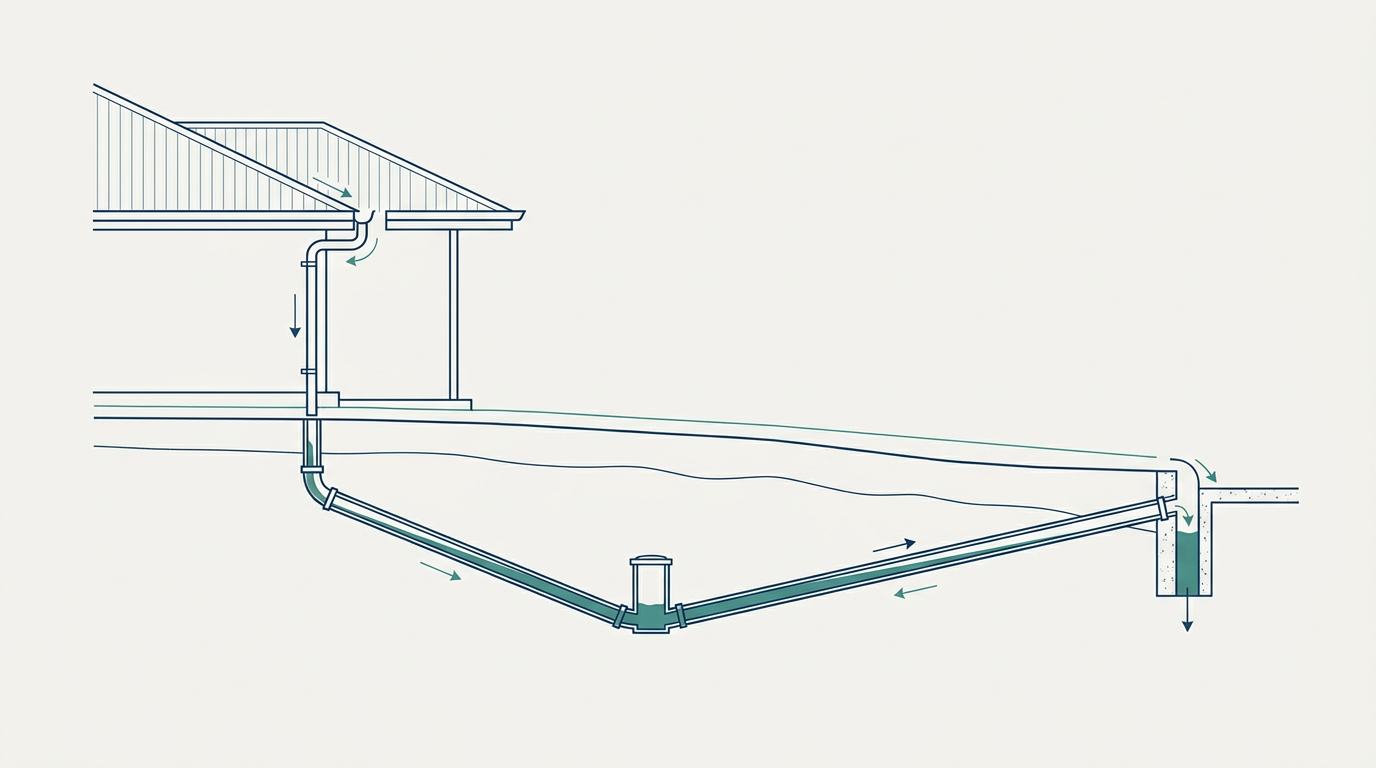
There is a pipe under your yard that is meant to sit full of water all year and nobody ever told you about it. On the steep blocks around Northbridge, Hornsby, Merewether and the ridges above Gosford, roof water often cannot run downhill to the kerb in a straight fall, so the plumber ran it down, along and back up again, sealed the whole line and let water pressure push it out at the street. That is a charged stormwater system, and it works beautifully until the sediment that settles in the low part of the loop builds up past the point where a downpour can shift it. Then the first serious September storm arrives, the gutters overflow, the downpipe backs up, and water finds the wall cavity or the garage slab instead of the kerb. Right now, with spring storms building across the coast and Sydney Water charges higher than they were a year ago, this is the cheapest week of the year to look inside that pipe. Here is how the system works, how to tell yours is failing, and what fixing it costs in 2026.
Why So Many Sydney Homes Have a Pipe That Runs Full of Water
A normal stormwater drain is a gravity drain. Water enters a downpipe, falls into a pipe laid on a constant grade, and runs out at the kerb or into a pit. It only ever holds water while it rains.
A charged system exists because plenty of Sydney blocks refuse to cooperate with that idea. The house sits below the street, or a rock shelf sits in the way, or a pool and a slab took the only line that had fall in it. So the drainage is designed as a sealed loop instead. Water drops from the downpipe, travels underground below the level of both ends, then rises again under the pressure of the column of water behind it and discharges at the kerb.
Because the low section never empties, plumbers also call these wet systems or pressurised lines. On a well built one, the standing water is not a fault. It is the mechanism.
The design shows up all over our service areas. Steep harbourside streets in Mosman, Castlecrag and Greenwich use it constantly. So do the escarpment streets in Merewether and Dudley, the ridge blocks around Wyoming and Point Frederick, and thousands of 1980s and 1990s battleaxe developments where the new house went in behind the old one with no straight run to the street.
You will also find charged lines feeding rainwater tanks, where the underground loop carries roof water from several downpipes to a single tank inlet.
How a Charged System Is Supposed to Work
Three things make a charged line function. Lose any one and the system starts holding water where you do not want it.
The first is a sealed pipe. Every joint has to be solvent welded and pressure tight, because the line carries head pressure rather than open flow. Ordinary push together gravity fittings will weep under load.
The second is the height difference. The outlet at the kerb must sit lower than the top of the downpipe so the water column has somewhere to push. Builders often lose this margin later when a driveway is raised or a garden bed is built up.
The third is the inspection riser and its cap. That short vertical pipe at the low point of the loop is the only access anyone has to the buried section, and it doubles as a relief point if pressure builds.
Because the system is closed, it also does not self clean. A gravity drain scours itself every time a decent shower runs through it. A charged line drops its grit into the standing water and keeps it.
- Sealed, solvent welded pipework rated for pressure, not gravity fittings
- An outlet at the kerb or pit set lower than the highest inlet
- An inspection riser with a removable cap at the lowest point
- A silt or leaf arrestor at the top of each downpipe entry
- Clear separation from the sewer, since the two systems must never be joined
The Spring Warning Signs Worth Acting On
A charged line fails gradually and then all at once. For two or three seasons it copes with light rain and only struggles in a downpour, which is exactly when nobody is outside watching it.
September is the month it announces itself. The Bureau of Meteorology publishes seasonal climate outlooks and live severe weather warnings for New South Wales, and the first east coast trough of spring usually delivers more rain in twenty minutes than the previous fortnight combined.
Any one of the following is worth a look. Two together means the loop is already holding more silt than it can pass.
- Gutters that overflow in heavy rain even though they are clean
- A downpipe that gurgles, burps or backs up at ground level during a storm
- Water surging out of the inspection riser cap, or a cap that has popped off
- A kerb outlet that trickles long after the rain stops, or one that never runs at all
- A soggy strip of lawn or a mossy patch tracing the buried pipe line
- Silt fans or gravel spreading across the driveway after a storm
- Damp brickwork, a musty garage or efflorescence on a retaining wall near the line
- A stormwater pit that stays full for days
What Actually Blocks a Charged Line
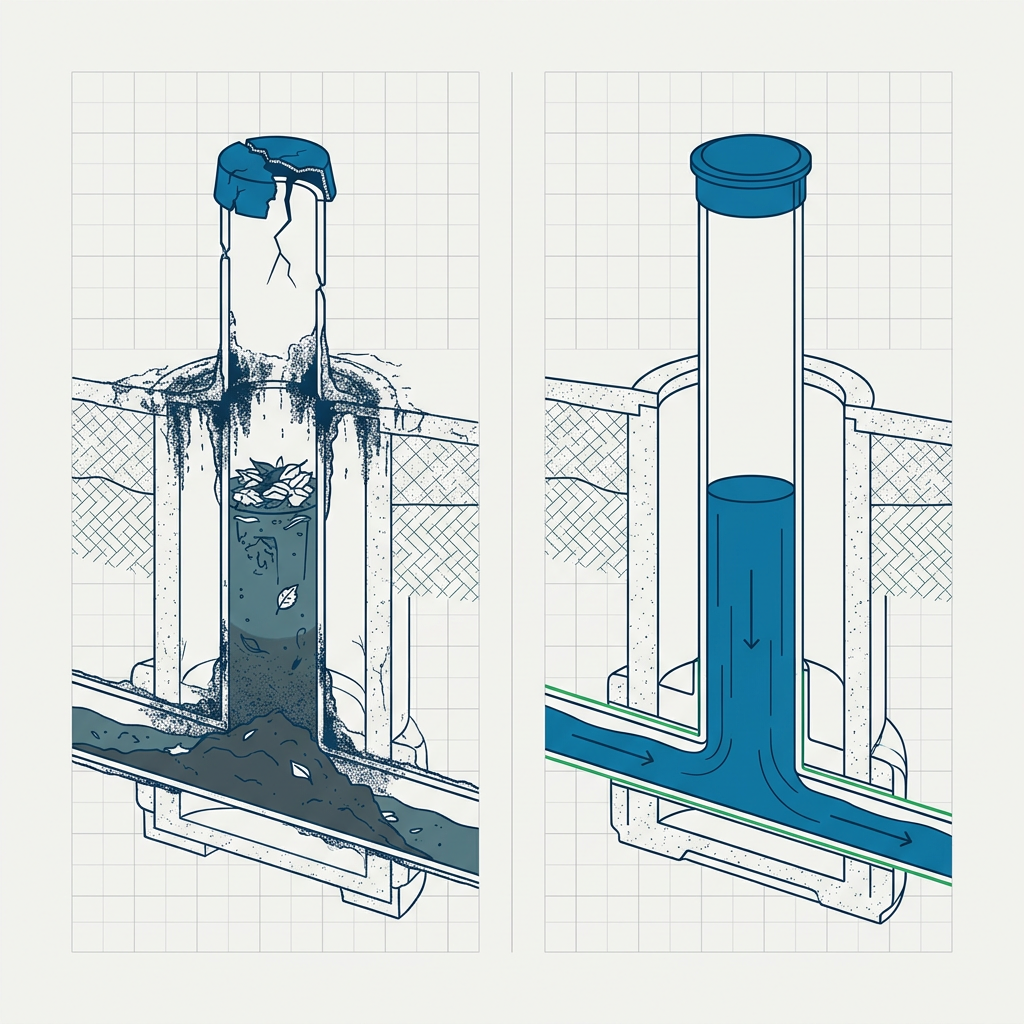
The blockages we cut out of charged systems look nothing like a kitchen or sewer blockage. There is no fat and no toilet paper. There is weight.
Roof sediment is the main offender. Tile grit, moss, gum leaf litter and the fine ash and dust that settles on a Sydney roof washes into the downpipe, reaches the still water in the loop and stops moving. Over a decade it packs into a dense grey sludge that sets like soft mortar.
Sand is the coastal version of the same problem. Around Terrigal, Long Jetty, Merewether and Dudley, wind driven sand loads the roof and gutters year round, and sand settles faster and packs harder than leaf litter.
Roots come third but do the most damage. A charged pipe is a permanent water source at root depth, which is the single most attractive thing in a dry Sydney summer for a liquidambar, camphor laurel or a neighbour's fig. Our guide to tree roots in drains covers how they get through a joint in the first place.
- Roof grit and moss washed off tiles, compacted into sludge at the low point
- Gum leaves, bark strips and seed pods from surrounding bushland canopy
- Coastal sand in beachside and lake suburbs
- Builders' waste from a renovation, including mortar slurry and render washings
- Fine roots through a weeping joint, then a full root mass once water is found
- A collapsed or crushed section under a driveway laid over the line
- A stormwater pipe wrongly joined to the sewer during past work, which is a separate and serious problem covered in our stormwater and sewer misconnection guide
What the 2026 Sydney Water Price Rise and the Hidden Leak Allowance Mean Here
Water in Sydney costs meaningfully more than it did two years ago. The pricing determination that took effect from 2025 lifted both the usage rate and the fixed service charges, and households have been feeling it in every quarterly bill since. You can read the current rates and charges on the Sydney Water accounts and billing pages, and we break each line down in our plain English bill guide.
That price rise matters to stormwater for one blunt reason. When a bill jumps, most people assume the cause is drinking water escaping somewhere, and they start looking for a leak. Sydney Water's Hidden Leak Allowance can credit part of a bill inflated by a concealed leak on a private drinking water line, provided the leak was genuinely hidden and you fixed it promptly once found.
Here is the part that catches people out. A blocked or leaking charged stormwater line will not trigger that allowance, because rainwater never passed through your meter. The wet patch in the lawn looks identical, the damage to the slab and the wall looks identical, and the repair bill is real, but the credit does not apply.
So the two jobs have to be told apart before you spend anything. If the water is metered, you are chasing a supply leak and the allowance is worth pursuing. If it only appears after rain, you are chasing the stormwater loop and the money is better spent on a camera and a flush than on a claim.
The practical takeaway for spring is simple. Fixing the stormwater now costs a few hundred dollars. Letting it surcharge into a wall cavity through three months of storms costs a rectification job, and no water utility credit exists to soften it.
How We Clear and Inspect a Charged Stormwater Line
Clearing a charged line is not the same job as clearing a gravity drain, and using the wrong method on one is how pipes get cracked.
We start at the riser, because that is where the sediment sits. The cap comes off, the standing water level tells us straight away whether the line is passing anything, and a drop test shows how fast it recovers.
Then the line gets flushed rather than rodded. High pressure water jetting with a low flow, high scour head lifts packed silt and carries it out at the kerb outlet, working with the direction of flow instead of pushing a plug further into the loop. A mechanical eel in a charged line tends to bore a hole through the sludge and leave the rest in place, so the problem returns within a season.
A CCTV drain inspection follows the flush, not the other way around, because a camera in dirty standing water shows nothing useful. Once the line runs clear we push the camera through to locate the low point, measure the fall, and record any cracked joint, root entry or dropped section on video.
Where the survey finds broken pipe rather than sediment, pipe relining can seal the run without digging up the driveway, provided the pipe still holds its shape. If the line has collapsed or the grade is genuinely wrong, the fix is a dig and a rebuild, and we would rather tell you that from the footage than guess.
What It Costs in 2026
Every job is quoted before we start, and the price we give on site is the price on the invoice. These are the realistic bands for charged stormwater work across Sydney, Newcastle and the Central Coast this spring.
Access is the single biggest variable. A riser sitting in an open lawn is a straightforward morning. A riser buried under pavers behind a pool fence, on a block where the truck parks two hundred metres away, is not.
- Riser location and silt flush on a single accessible line: from $165 to around $450
- Full jetting of a charged loop with a blocked kerb outlet: roughly $450 to $850
- Post clear CCTV survey with recorded footage and a written report: commonly $250 to $500, often bundled with the clearing
- Root cutting through a charged line plus flush: about $600 to $1,200 depending on length
- Relining a damaged section of charged pipe: usually $2,000 to $6,000 depending on run length and diameter
- Excavation and replacement of a collapsed section under paving or driveway: quoted per job after the camera survey
- Annual preventive flush on a known problem line: typically the low end of the clearing range
Getting Ahead of the Storm Season
Storm season on this coast runs from spring through to autumn, and the NSW SES publishes practical household preparation advice each year for exactly that window. Stormwater is the part of the house most people forget until water is already inside.
Most of the following you can do yourself in an hour on a Saturday. The rest needs equipment.
If your property is a strata scheme, note that stormwater lines serving common property are usually the owners corporation's responsibility, and NSW Fair Trading sets out the split in its strata repairs and maintenance guidance. Get the flush onto the maintenance schedule rather than paying for it as an emergency.
- Clear gutters and downpipe entries before the first big spring storm, not after
- Find your inspection riser now and mark it, so nobody has to hunt for it in the rain
- Replace a cracked or missing riser cap, since an open riser swallows leaves and soil
- Check the kerb outlet is visible and not buried by turf, mulch or a council footpath repair
- Fit leaf guards or a silt arrestor at each downpipe if your roof sits under a heavy canopy
- Watch the outlet during the next downpour and note whether it runs strongly or dribbles
- Book a flush every two to three years on a treed block, and yearly on a coastal sand block
- Never connect a new downpipe, tank overflow or pool backwash into the line without a licensed plumber, since the rules for connections are set out by Sydney Water
When the Problem Is the Design, Not the Blockage
Sometimes the line was never going to work. We see charged systems built with gravity fittings that weep under pressure, outlets set too high after a driveway rebuild, and loops running to a kerb that the council has since raised.
Renovations create a version of this too. Add a second storey or a large alfresco roof and you have increased the catchment feeding a pipe sized for the original house. The old loop passes a light shower and floods in a real storm.
On larger or newer properties there may also be an on site detention tank, sized during the development approval to hold peak flow and release it slowly. Those tanks have their own outlets and screens, and they silt up just like the pipe does. Councils and the NSW planning system set the requirements for them, and the NSW environment agency publishes the water quality reasoning behind why roof and surface water is managed separately from sewage.
Whoever does the work has to be licensed. Stormwater and drainage work in New South Wales sits under NSW Fair Trading plumbing and drainage licensing, and an unlicensed cheap fix on a pressurised line usually fails at the joints.
The honest summary is this. A charged stormwater system is a good solution to a hard block, and it will outlast most of the house if someone flushes it occasionally. Left alone for twenty years it turns into a buried tank of wet grit with your roof water banked up behind it. If your gutters overflowed in the last storm, or the riser cap is off, get a camera in the line while the weather is still on your side. Call us on 0420 101 994 for stormwater drain clearing across Sydney, Newcastle and the Central Coast, or 24/7 emergency help if water is already coming inside.
Book a charged stormwater flush and camera check before the storm season peaks
Express Drain Cleaning provides same-day drain clearing across Sydney, Newcastle and the Central Coast. Licensed, insured, upfront pricing.