
How to Read Your Water Meter in Sydney and Catch a Hidden Leak Before the Next Bill
Walk out to the front fence of almost any weatherboard in Marrickville or brick-and-tile in Hornsby and there is a green plastic lid sitting flush with the lawn. Most owners have mown over it for years without lifting it. That lid is the only honest witness you have when a water bill lands higher than the last one, and this August it is being lifted a lot. The Sydney Water prices that IPART approved from 1 October 2025 are now flowing through a full year of quarterly bills, so the winter accounts arriving right now are the first many households can compare against a like-for-like period at the new rates. Our phones ring the same way every August. The bill is up by hundreds of dollars, the house has not changed, and nobody can find a puddle. Nine times out of ten the answer is under that green lid, spinning quietly while the family sleeps. This guide shows you exactly how to read your meter, how to run the overnight test that separates a real leak from ordinary use, what the Hidden Leak Allowance will and will not give back, and when high usage is really a drainage fault rather than a supply one.
Why Sydney Bills Are Climbing and Why the Meter Settles the Argument
Water bills in Sydney now carry two charges that behave very differently. There is a fixed service charge that arrives whether you use a drop or not, and there is a usage charge for every kilolitre that passes through the meter. Only the second one moves when something is leaking. That is why comparing bill totals between quarters tells you almost nothing useful, and why a meter reading tells you almost everything.
The pricing changes that took effect under the IPART determination for Sydney Water lifted both parts of the account. A leak that would have been an annoying $300 problem three years ago is now a $600 or $900 problem across the same quarter, because every wasted kilolitre is charged at a higher rate. Households in older suburbs feel it hardest, since the pipework doing the leaking is usually the oldest pipework in the street.
Winter makes it worse in a way most people do not expect. Cold ground contracts around old copper and earthenware, joints that were only just holding through summer start to weep, and heavy rain hides the evidence. A wet patch in a Willoughby back lawn in August looks like ordinary winter ground. In February the same patch would have been obvious against dry grass. The Bureau of Meteorology seasonal summaries for New South Wales are a useful sanity check when you are trying to work out whether a soggy corner is rain or something else.
The meter cuts through all of it. It does not care about the weather, the season or what anyone remembers doing with the hose. If the dial moves when nothing in the house is running, water is leaving your system through a hole you have not found yet.
Where Your Water Meter Is and How to Read It
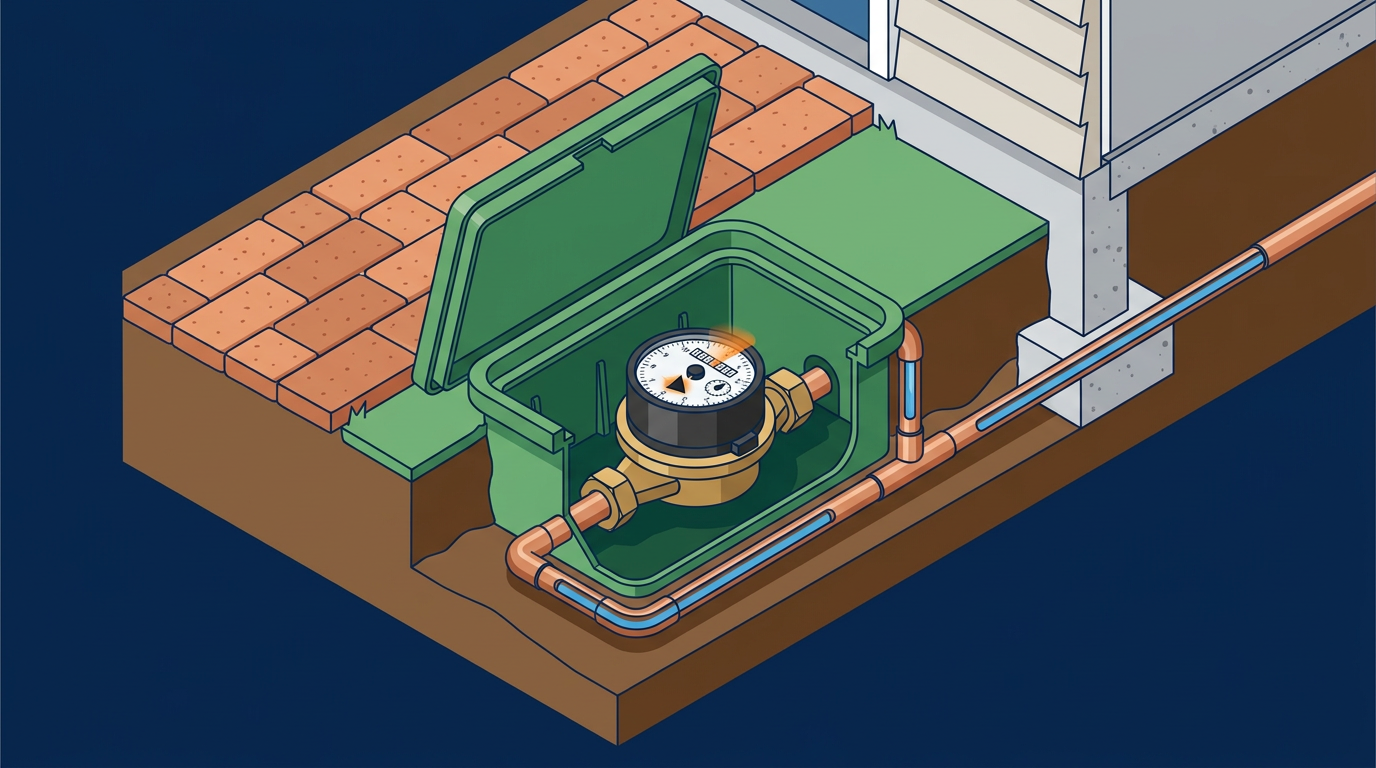
In most Sydney homes the meter sits inside a green or black plastic box near the front boundary, usually within a metre or two of the footpath and often on the same side as the front tap. Terraces in Newtown and Balmain frequently have theirs set into the front path itself. Apartment blocks and duplexes may have a bank of meters in a cupboard near the driveway entrance, one per unit, with the lot number stamped on a small tag.
Lift the lid with a screwdriver rather than your fingers. Redback spiders like these boxes, and so do cane toads on the Central Coast. Clear out the leaf litter, wipe the glass with a rag, and give your eyes a moment to adjust to what is a genuinely ugly little dial.
The numbers split into two groups. The black or white digits on the left are kilolitres, which is what you are billed on. One kilolitre is a thousand litres. The red digits, or the smaller dials on older meters, are litres. Those red numbers are the ones that matter for leak hunting, because a slow leak may take days to move a single kilolitre but will crawl through litres steadily.
Write the full reading down, red digits included, with the date and time next to it. A photo on your phone is even better because it timestamps itself and captures the serial number, which you will need if you ever lodge a claim. Sydney Water sets out the same basics on its leak detection page, and Hunter Water customers can find equivalent guidance through Hunter Water.
- Black or white digits: kilolitres, the unit you are charged for.
- Red digits or small dials: litres, the unit that exposes slow leaks.
- Small spinning triangle, star or disc: the leak indicator, which turns whenever any water is flowing.
- Serial number on the face: quote this when you contact your water utility.
The Overnight Meter Test Every Sydney Homeowner Should Run
This is the single most useful thing you can do before calling anyone. It costs nothing, takes two minutes of actual effort, and produces a number a plumber can act on immediately.
Pick a night when the household is settled. Turn off every tap, stop the washing machine and dishwasher mid-cycle if either is running, and switch off any irrigation timer at the controller rather than at the tap. If you have an ice maker or a hot water system on a timer, note it, because both can draw water quietly overnight.
Read the meter last thing before bed and photograph it. Nobody uses water until morning, including the 2am toilet visit, which is the step most people fail. Read it again first thing and photograph it a second time. Any movement at all in the red digits means water moved through your meter while the house was asleep.
Convert what you see into a daily figure. If the red digits moved 40 litres across eight hours, that is roughly 120 litres a day, or about 11 kilolitres over a quarter. At current Sydney usage rates that is real money, and it will keep repeating on every bill until the cause is fixed.
One caution for shared driveways and duplexes in places like Ryde and Gosford. Some older properties still share a single meter across two dwellings, so an overnight movement may belong to the neighbour. Check the meter tag and the plumbing history before assuming the leak is yours.
What the Leak Indicator Triangle Is Actually Telling You
Nearly every meter installed across Sydney in the past twenty years has a small triangle, star or silver disc set into the face. It spins whenever water passes, however slowly. Plumbers use it constantly because it responds faster than the digits.
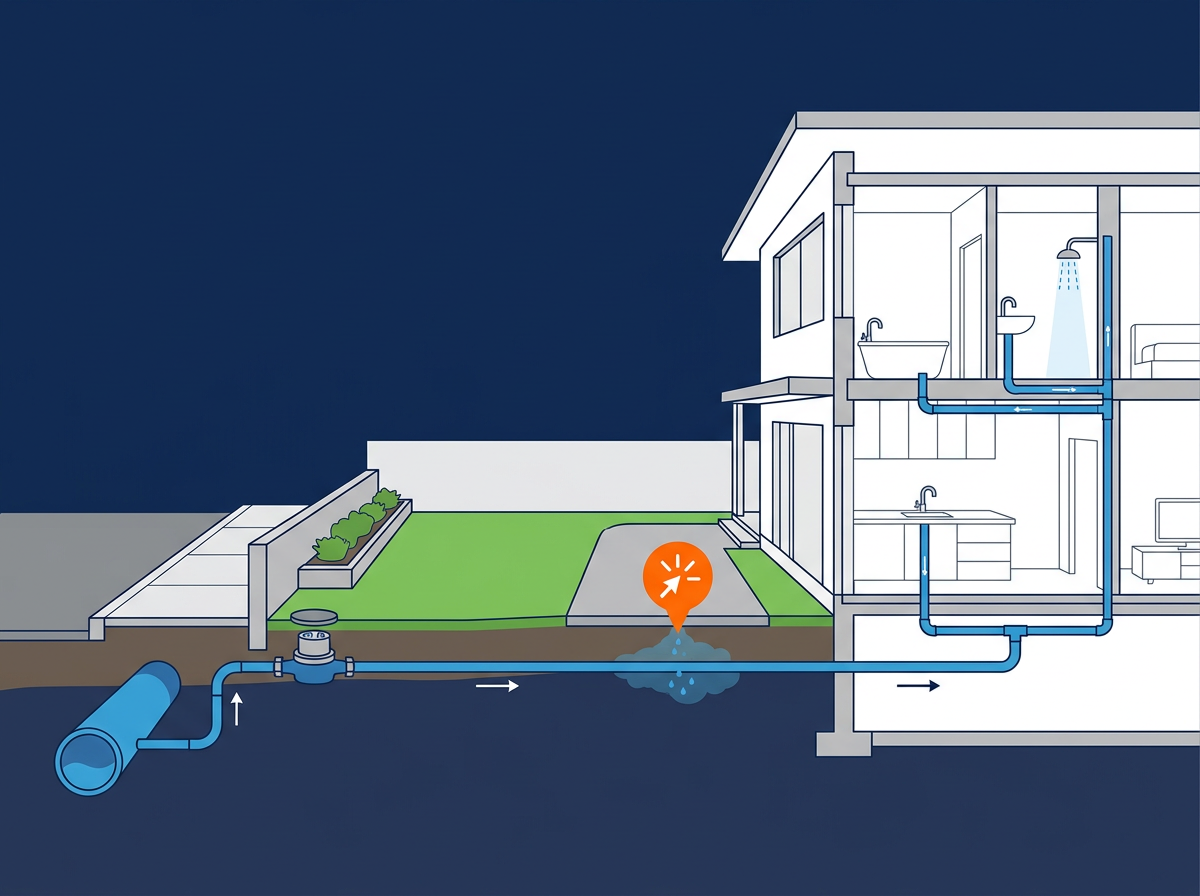
With everything in the house off, crouch down and watch it for sixty seconds. A steady spin means a substantial leak, likely litres per minute, and often a burst service line or a failed cistern. A slow creep, where the triangle rotates once every twenty or thirty seconds, points to a pinhole, a weeping joint or a dripping outlet. Absolute stillness is a clean result for supply pipework, though it does not rule out a drainage fault.
You can narrow the location without digging anything up. Find the main stop tap at the house, usually near the front tap or in the meter box itself, and close it. If the triangle stops, the leak is inside or under the house. If it keeps spinning with the house isolated, the leak is in the buried private supply line between the meter and the building, which is the section that runs under driveways, paths and garden beds in almost every Sydney block.
That distinction changes the repair completely. Internal work is usually a few hours. A leaking service line under a stamped concrete driveway in Mosman is a different conversation, and it is one worth having before the bill compounds.
Where Sydney Homes Actually Leak
After enough call-outs across the North Shore, the Inner West, Newcastle and the Central Coast, the same handful of causes account for most of what we find.
- Copper supply lines in homes built before 1980, where decades of slightly acidic water have thinned the wall until a pinhole opens.
- Poly service lines joined with old compression fittings that loosen as clay soils swell and shrink through wet winters.
- Toilet cisterns with a worn flush valve, quietly moving up to 260 litres a day into the sewer with no visible sign.
- Irrigation solenoids that fail part open, which shows up as a green stripe of lawn in the middle of August.
- Hot water system pressure relief valves discharging continuously to a drain instead of occasionally.
- Garden taps and hose fittings weeping into a garden bed where the water never pools.
When High Usage Is Really a Drainage Problem
Not every ugly bill is a supply leak, and this is where a lot of Sydney homeowners waste money chasing the wrong trade. If the meter is dead still overnight but the household is still seeing water where it should not be, the fault is on the waste side of the property rather than the supply side.
Sewer and stormwater faults produce a different set of symptoms. Water pools around an overflow relief gully after rain, a bathroom smells like sewage in the morning, gurgling comes from a floor waste when the washing machine drains, or the lawn stays wet in one spot long after the weather clears. Those are blockage signals, not leak signals, and tree roots are behind a large share of them across established suburbs.
Both problems can also arrive together. A cracked earthenware sewer line lets roots in, the blockage causes surcharge, and the water sitting under the slab eventually gets blamed on a supply leak that does not exist. The only way to separate them properly is to look, which is what a CCTV drain inspection is for. A camera run tells you whether you are dealing with roots, a collapse, a misconnection or nothing at all.
If the camera finds a broken line, the fix is usually pipe relining rather than excavation, which matters when the damaged section sits under a driveway or a heritage front path.
The Hidden Leak Allowance: What Sydney Water Will Give Back
This is the part most Sydney households do not know exists, and it is worth real money. Sydney Water runs a concession called the Hidden Leak Allowance for leaks that a reasonable person could not have seen. Underground service lines, pipes under slabs and pipes inside wall cavities all qualify. Dripping taps, running toilets and garden hoses do not, because you could have seen them.
The rules are specific and the paperwork matters. You generally need to show that the leak was concealed, that you had it repaired by a licensed plumber within a reasonable window once you knew about it, and that your usage returned to normal afterwards. The allowance is applied as a credit against the excess usage rather than a refund of the whole bill, and it is not something you can claim repeatedly for the same fault.
Keep three things from day one. Keep your before and after meter photographs with their timestamps. Keep the plumber's invoice with the licence number, the address and a plain description of what was repaired and where. Keep the next bill that shows usage back at normal levels. A claim with those three items attached moves quickly. A claim with a vague receipt and no readings usually does not.
Licensing is not a formality here either. Work must be done by a licensed plumber or drainer under NSW Fair Trading rules, and materials and installation are expected to meet the National Construction Code. An unlicensed cash job can void the claim entirely, which turns a saving into a loss.
Renters, Landlords and Strata: Who Reads the Meter and Who Pays
Meter questions get complicated the moment more than one party is involved, and August is when those arguments start because that is when the winter bill lands.
For a rented house in New South Wales, a tenant can only be charged for water usage if the property is separately metered and meets the efficiency requirements set out in the NSW rules on water supply to rental properties. A concealed leak is not tenant consumption. If the meter shows an overnight loss, the tenant should report it in writing to the agent immediately, keep a copy, and stop paying usage on water that never reached a tap.
Landlords should treat a leak report as urgent for a plain commercial reason. The clock on the Hidden Leak Allowance starts when the fault becomes known, and a repair delayed for a month of quotes can cost more in unclaimable usage than the repair itself.
Strata is different again. Most older Sydney blocks have one master meter for the whole building, so a single failed cistern in one lot can inflate the levy for everyone. If the block has no sub-metering, the only practical approach is to isolate lots one at a time and watch the master meter. Our guide to strata water leaks in Sydney covers how that investigation usually runs and who ends up wearing the cost.
Newcastle and Central Coast Meters Are Not the Same
The method is identical but the administration is not. Newcastle and Lake Macquarie properties are supplied by Hunter Water, and Central Coast properties from Woy Woy to Toukley are supplied by the local council authority. Both bill on their own cycles and both run their own concessions, so the Sydney Water Hidden Leak Allowance does not automatically apply to a house in Charlestown or Kincumber.
The physical differences matter too. A lot of Central Coast blocks sit on sand, which swallows a leaking service line without ever showing a wet patch. Newcastle has a large stock of post-war homes with original galvanised and early copper supply lines, and those fail at joints rather than in the middle of a run. In both areas we find leaks by meter reading and pressure testing rather than by looking for surface evidence, because the surface rarely gives anything away.
Wherever the property sits, the overnight test is the starting point and the numbers travel well. A photographed reading from midnight and another from 6am is the same evidence in Hamilton as it is in Hornsby.
A Simple August Routine That Stops Bill Shock
Spring storm season is close, and the properties that cope best are the ones that got their checks done in the quiet weeks beforehand. None of this takes long.
Read the meter on the first Sunday of every month and photograph it. Twelve readings a year turn an unexplained bill into a chart where the problem month is obvious. Run the overnight test once a quarter, ideally in the week your bill arrives, so a rise never gets more than one cycle to build.
Once a year, do the round of things that are cheap to check and expensive to ignore. Drop food colouring into every toilet cistern and wait ten minutes. Walk the irrigation zones with the controller running. Look at the pressure relief valve on the hot water system. Clear the leaf litter out of the meter box so you can actually read the thing when it matters.
If the house has a history of blockages rather than leaks, add a jetting and camera check before the heavy rain arrives. Clearing a line with drain jetting in late winter is a fraction of the cost of an after-hours callout when a storm surcharges a full sewer line into a laundry.
What to Do Next If Your Meter Is Moving
A moving meter with the house switched off is not a maybe. It is water leaving your property and being charged to you at the current rate, every hour, until someone finds it.
Start by isolating the house at the main stop tap so you know which side of the building the fault sits on. Photograph the meter with the time visible. Note anything unusual you have seen in the past month, including damp patches, drops in pressure, or a hot water system running longer than it used to. Then call a licensed local drainer and hand over that information, because it removes an hour of guesswork from the visit.
Our team runs meter tests, pressure tests, acoustic leak location and camera inspections across the Sydney North Shore, the Inner West, Newcastle and the Central Coast, seven days a week. If we find a concealed leak we document it properly so your Hidden Leak Allowance claim has everything it needs, and if the fault turns out to be on the drainage side we can clear or reline it in the same visit. Call 0420 101 994 or book a drain inspection and get the number under control before the next quarter closes.
Meter Still Ticking Overnight? Book a Same-Day Leak and Drain Check
Express Drain Cleaning provides same-day drain clearing across Sydney, Newcastle and the Central Coast. Licensed, insured, upfront pricing.