

EOFY 2026: Drain Repair Deductions Sydney Landlords Miss
Every June, accountants in Surry Hills, Parramatta and Chatswood field the same call from rental property owners: the tenant in the Newtown terrace reported a slow shower in April, the plumber's invoice landed in May, and now the owner wants to know whether the $4,200 pipe reline is a deduction this financial year or a depreciating capital improvement spread over forty. By the time the question is asked, the answer is usually locked in by how the invoice was written, not how the work was done. With 30 June 2026 eight days away and Sydney Water's drainage charges climbing into the new IPART pricing period, this is the week to get the paperwork right. This guide is for Sydney investment property owners, small portfolio landlords and self-managing strata investors who want a plain answer on what drain work the Australian Taxation Office treats as an immediate repair, what it treats as capital, and what to do between now and 30 June to keep more of the deduction.
1. Why Drain Repairs Are the Most Misclassified Deduction on Sydney Rental Returns
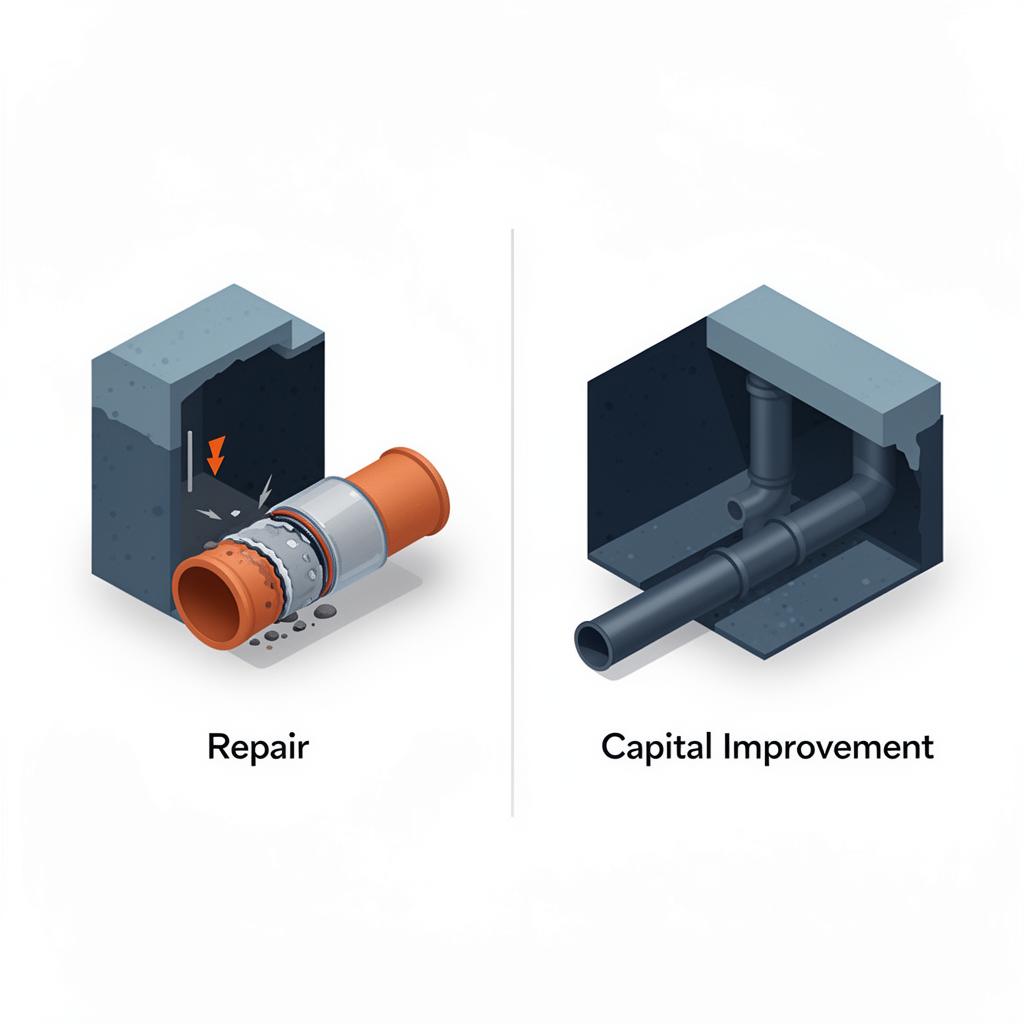
Drain work sits in an awkward middle ground in the ATO's rental property guidance. The hole in the ground looks the same whether the plumber patched a cracked joint or replaced an entire lateral, but the tax treatment is very different. A repair to restore an existing pipe to its working condition is deductible in the year you pay for it. A replacement that materially improves the asset, or installs something that was not there before, is capital and depreciates over the effective life of the new asset.
Sydney's housing stock makes this harder than it sounds. A 1920s terrace in Erskineville on its original earthenware sewer line, a 1970s brick veneer in Eastwood on early PVC, and a 2010 townhouse in Rouse Hill all fail in different ways and attract different tax outcomes. The ATO's guidance on repair and maintenance expenses for rental properties is the current reference, and it is unambiguous on one point: it is the nature of the work, not the cost, that decides the category.
2. The Repair vs Capital Test in Plain English
A repair fixes damage or deterioration on something that already existed and was already working as part of the income-producing asset. The classic Sydney examples are a CCTV inspection of an existing sewer line, jetting tree roots out of a clay joint, patching a cracked section, or rehanging a slipped boundary trap. The pipe was there, it carried wastewater, it failed, you restored it.
- Repair: clearing a root mass from an existing clay sewer with a high-pressure jetter.
- Repair: replacing a one-metre section of fractured PVC inside an existing run.
- Repair: rehanging or resealing a boundary trap that has slumped over time.
- Repair: descaling and rejetting a shared sewer stack in a strata block.
- Capital improvement: lining a full sewer lateral end to end with a structural cured-in-place liner where there was previously only the original pipe.
- Capital improvement: installing a new stormwater pit, easement line or pump well that was not on the property before.
- Capital improvement: full replacement of the lateral from the boundary trap to the house using a different material to a higher specification.
3. The 30 June 2026 Timing Rule Most Sydney Landlords Get Wrong
Deductions follow the date you incurred the expense, not the date you booked the job. For a cash-basis rental owner, that usually means the date the invoice was paid. For an accrual-basis taxpayer it is the date the liability arose, which is typically the invoice date.
If you have a drain issue at a Sydney rental right now, the practical implication is sharp. A job booked, completed and invoiced before 30 June 2026, with payment made before 30 June 2026, is a 2025-26 deduction. The same job, same pipe, same plumber, invoiced on 2 July 2026, is a 2026-27 deduction. For an owner on the 37 cent marginal rate, a $5,000 repair brings forward roughly $1,850 of tax relief by twelve months. For an owner at 45 cents, it is closer to $2,250.
- Schedule the CCTV drain camera inspection before 30 June if you suspect an issue.
- Pay the invoice before close of business on 30 June 2026, not in the first week of July.
- Ask the plumber to itemise the invoice so repair and capital components are clearly separated.
- Keep a copy of the camera report with the invoice. The footage is the evidence the work was a repair to existing damage.
4. What Sydney Landlords Can Claim This Financial Year
The following are the drain-related items most commonly deductible in the year paid, when the work is at a tenanted Sydney investment property. This is general guidance, not personal tax advice, and your accountant should confirm against your individual facts.
- Emergency call-outs to clear a blocked toilet, sink or floor waste reported by the tenant. Our 24/7 emergency drain service issues itemised tax invoices on the spot.
- Hydro-jetting and electric eel work to clear roots, grease or silt from an existing line. The comparison in our hydro-jet vs electric eel guide helps you understand the invoice.
- CCTV drain inspections used to diagnose a fault or to document the condition of an existing system after a tenant complaint. Typical 2026 pricing is set out in our CCTV drain inspection cost guide.
- Patch repairs and short-section pipe replacements that restore the existing line without extending or upgrading it.
- Boundary trap clean-outs and the resealing of inspection openings.
- Annual preventative maintenance jetting on a sewer line with a known history of root intrusion in suburbs like Wahroonga, Killara or Lane Cove.
- Stormwater pit clean-outs and the clearing of leaf and silt build-up. Our stormwater drain maintenance guide covers the routine scope.
- Travel costs to inspect the property in connection with the repair, where the trip was solely for that purpose.
5. What Has to Be Depreciated, Not Deducted
These items improve the property beyond its previous state or introduce a new asset. They are capital and depreciate under Division 43 (capital works, generally 2.5% per year over forty years for plumbing built into the structure) or Division 40 (depreciating assets, with shorter effective lives for separately identifiable plant items).
- Full-length structural relining of a sewer lateral where the existing line had already failed end to end.
- Installation of a new stormwater absorption pit, soakwell or detention tank.
- Replacing a galvanised stormwater system with new PVC across the whole property.
- Adding a new sewer line to a previously unconnected granny flat or studio.
- Installing a sewage ejector or grinder pump where none existed before.
- Upgrading a 100 mm stormwater line to 150 mm across its full length.
6. Strata-Owned Pipes, Shared Lines and Your Investment Unit
If you own a unit in a Bondi walk-up, a Zetland tower or a North Sydney 1970s brick block, the sewer stack and most of the stormwater is owned by the owners corporation, not by you. The strata levy that funds shared plumbing repairs is generally deductible to you as a rental expense in the year you pay it, whether the underlying work was a repair or capital. The capital portion sits inside the strata's books, not yours.
The position is different for a special levy raised to fund a major capital project, such as full replacement of the building's stormwater system. That portion is usually not immediately deductible and instead forms part of your cost base for capital works depreciation. The ATO's guidance on common property expenses and body corporate fees sets out the split.
On private plumbing inside your unit, the test is the same as for a standalone house. A blocked kitchen sink in your lot is your repair. A failed riser shared with the unit above is the strata's repair, even if the symptom appeared in your kitchen.
7. The 2026 Sydney Water Price Step and What It Means for Your Return
The Independent Pricing and Regulatory Tribunal sets Sydney Water's prices in multi-year determinations. The 2025 determination introduced annual step changes in usage and service charges from 1 October 2025 through to 30 June 2030, with the next step landing in 2026. The full pricing schedule is published on the IPART Sydney Water pricing determination page.
For a rental owner, the practical consequence is that Sydney Water service and usage charges paid in the 2025-26 year are deductible at the rates that applied during that year, and the new rates only start affecting deductions from the 2026-27 return. If your tenant pays usage charges directly, those are not your deductions. The fixed service charge on the account in the owner's name is.
A hidden leak at the rental that ran undetected during winter can also trigger Sydney Water's hidden leak allowance. Once the leak is fixed by a licensed plumber and the report is lodged within the timeframes published on that page, Sydney Water may credit part of the excess usage charge. The credit reduces the expense you can claim, so make sure the deduction in your return matches the net amount you actually paid.
8. The Five Action Steps to Take Before 30 June 2026
Most of the value in this guide turns on what you do in the next week. The list below is the same one we walk Sydney landlords through every June.
- Pull the maintenance log for each rental and identify any drain issue reported by a tenant since 1 July 2025 that has not been resolved. An unresolved issue is also an unclaimed deduction.
- Book a pre-EOFY CCTV inspection on any property over thirty years old that has never had one. The footage and report dated before 30 June anchors any subsequent repair as restoring existing damage, not improving it.
- Ask any plumber holding a current job at your rental to invoice and accept payment before 30 June 2026 where possible. A part-paid invoice is only a deduction to the extent paid.
- Request itemised invoices that separate diagnostic work, repair work and any capital component. A single-line invoice for $6,000 forces the whole job into one category, usually the wrong one.
- Send the full set of invoices, camera reports and any strata correspondence to your registered tax agent at least two weeks before they prepare your return. Last-minute drain receipts are the ones most often missed in a Sydney landlord's deduction schedule.
9. What to Do This Week if Your Rental Has a Live Drain Issue
If a tenant has reported a slow drain, a gurgling toilet, a damp patch in the side passage or a surcharging gully at any Sydney rental in the last fortnight, this is the week to act. The combination of a wet Sydney winter, an ageing pipe network across the Inner West, Eastern Suburbs and Lower North Shore, and an EOFY deadline eight days away means a small repair done now is both cheaper and more tax-effective than the same repair done in August.
Start with a camera inspection so you have a dated, photographic record of the existing damage. Choose targeted repairs (jetting, short-section replacement, boundary trap reseal) over full-line capital upgrades where the system can be restored to working condition. Make sure every invoice is itemised, paid before 30 June, and filed with the camera report.
Sydney's rental drainage problems are not going away. The state's housing stock is older every year, the tree canopy is denser in the suburbs that already had the worst root intrusion, and the rainfall pattern is shifting toward heavier short bursts that test stormwater systems harder. Investors who treat drain maintenance as an annual line item, not an emergency, are the ones who keep both their tenants and their tax position in better shape. Eight days is enough to make the right call on a live job. It is not enough to wait.
Book a Pre-EOFY Drain Inspection at Your Sydney Rental
Express Drain Cleaning provides same-day drain clearing across Sydney, Newcastle and the Central Coast. Licensed, insured, upfront pricing.