
Stormwater Drain Maintenance: A Guide for NSW Homeowners
As the wet season approaches across Sydney, Newcastle, and the Central Coast, ensuring your home’s drainage system is functional becomes a top priority. Stormwater drain maintenance is the single most effective way to prevent localized flooding and structural damage during the heavy East Coast Lows that frequently batter the NSW coastline. From the old earthenware pipes of inner-west Sydney to the sandy soil challenges of the Central Coast, understanding your property’s specific drainage needs is essential for every homeowner.
Identifying Your Local Drainage Risks
In New South Wales, the geography of your suburb dictates your drainage risks. If you live in Sydney’s leafy North Shore or the Hills District, your primary enemy is root intrusion from established gums and deciduous trees seeking moisture in old terracotta pipes. Conversely, homeowners in coastal suburbs like Terrigal or Newcastle’s Merewether often deal with fine sand ingress and salt-air corrosion of metal components.
Regardless of your location, the legal responsibility for stormwater differs from sewerage. While Sydney Water or Hunter Water manages the sewage mains, your local Council (such as Northern Beaches, City of Newcastle, or Central Coast Council) oversees the public stormwater network. However, everything from your roof gutters down to the 'point of connection' at the street kerb or council easement is your responsibility to maintain. Ignoring a slow-draining pit now can lead to foundation subsidence or rising damp in your brickwork once the heavy rains arrive.
The Essential Stormwater Drain Maintenance Checklist
Before the first storm clouds gather over the Tasman Sea, work through this practical checklist to ensure your system can handle a high volume of runoff:
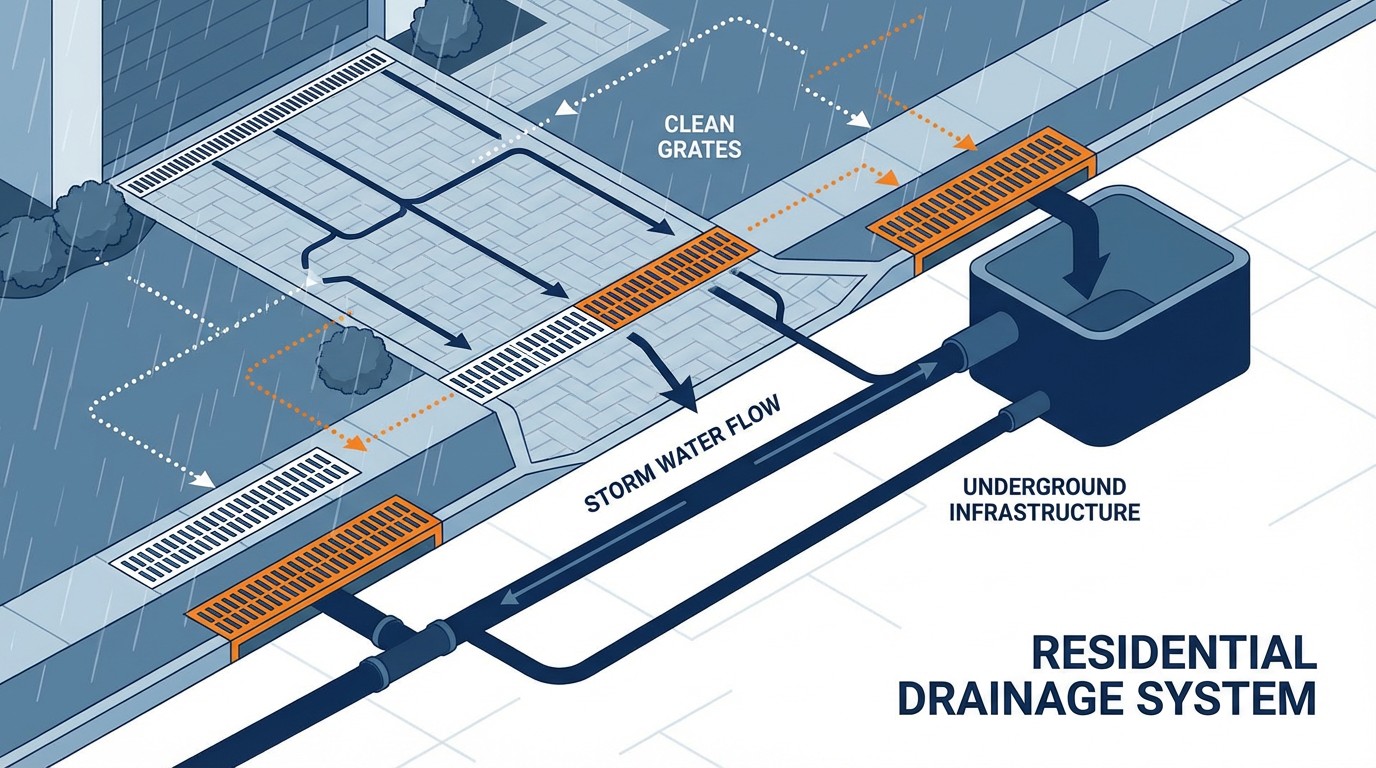
1. Surface Grates and Pits: Clear any debris from the grates in your driveway or garden. Lift the grates and reach inside (wearing heavy-duty gloves) to remove accumulated silt and rotting leaves. If the pit remains full of water during dry weather, there is a blockage further downstream.
2. Gutter and Downpipe Integrity: NSW homes often feature 'slotted' gutters designed to overflow away from the fascia, but if they are choked with debris from Sydney Blue Gums or Morton Bay Figs, water will back up into your eaves. Inspect the joins in your downpipes; if you see green algae or staining, water is leaking out under pressure.
3. Discharge Points: Check where your stormwater exits. If it discharges to the 'kerb and gutter', ensure the outlet isn't buried under street turf or silt. If you have an or-site detention (OSD) tank—common in newer builds across Western Sydney—ensure the discharge orifice is clear of obstructions.
Professional Maintenance Costs and Methods
Sometimes, a garden hose isn't enough to clear a blockage. When stormwater drain maintenance requires professional intervention, NSW plumbers typically use two primary tools: High-Pressure Water Jetters and CCTV Drain Cameras. A water jetter uses a motor to pump water at 5,000 psi through a nozzle that can cut through tree roots and flush out heavy silt that a standard hose cannot move.
In Sydney and Newcastle, a standard residential stormwater jetting service typically costs between $350 and $550. If your plumber suspects a broken pipe under a concrete driveway or garden bed, a CCTV camera inspection (priced between $200 and $450) is indispensable. It provides a visual recording of the pipe's interior, allowing for pinpoint accuracy when excavating or 'trenchless' relining. While these costs may seem significant, they are a fraction of the $10,000+ cost often associated with repairing cracked foundations or internal water damage caused by a backyard flood.
Dealing with Common NSW Pipe Materials
The era of your home largely determines what lies beneath your lawn. Many homes built before the 1970s in areas like Marrickville or Hamilton utilize Vitrified Clay (VC) pipes. These are prone to 'bell-and-spigot' joint failure, where the collar of the pipe cracks, allowing thirsty tree roots to enter. Once a root enters, it acts as a filter, catching silt and grease until the pipe is completely sealed.
Middle-aged homes often use uPVC pipes, which are more resilient to roots but can be crushed by heavy vehicles or soil movement in Sydney’s reactive clay. In some Newcastle beachside suburbs, you may even encounter old pitch fibre pipes—colloquially known as 'Black Betty'—which are prone to flattening over time. Understanding what material your system uses allows for a more targeted maintenance strategy; for example, clay pipes may require annual root foaming treatments, whereas PVC systems may only need a five-yearly flush to remove sediment.
Legal and Council Requirements for Stormwater
It is a common misconception that you can divert stormwater anywhere on your property. In NSW, 'The Law of Nuisance' and the Local Government Act dictate that you must not redirect water in a way that negatively impacts your neighbour’s property. This means you cannot simply aim a downpipe at the fence line.
Most Sydney and Central Coast councils require that stormwater be piped to a legal point of discharge. If you are planning a renovation or adding a granny flat, you will likely need to install a 'charged system' or a rainwater tank with an overflow. Failure to maintain these systems can result in Council 'Prevention Notices', which carry hefty fines. Regularly checking that your overflow valves are clear and that your pump-out systems (if you are on a low-lying block) are operational is not just good maintenance—it’s a legal necessity to avoid disputes with neighbours and authorities.
Protect Your Property Before the Next Storm Hits
Express Drain Cleaning provides same-day drain clearing across Sydney, Newcastle and the Central Coast. Licensed, insured, upfront pricing.